Home Blog Page 3

Fuel Tanker Inferno Rocks Bulawayo as Suspected Siphoning Incident Goes Wrong

0

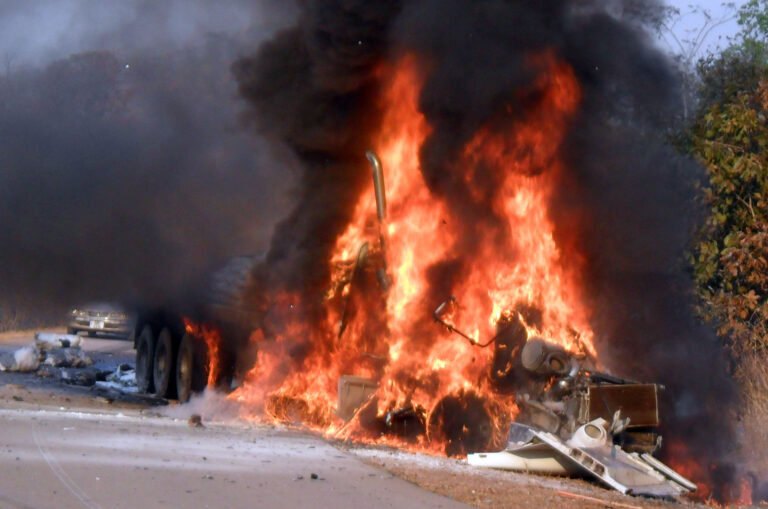
A massive fireball lit up the night sky in Bulawayo on Monday after two fuel tankers caught fire in the Donnington Industrial Area, triggering loud explosions that were felt across several surrounding suburbs.

The incident occurred along Goderich Avenue near Masiyephambili Road, close to a service station, where the two tankers, both reportedly carrying fuel, were engulfed in flames. While no fatalities have been reported, the blaze caused widespread alarm and significant damage in the area.

Bulawayo’s Chief Fire Officer, Mhlangano Moyo, confirmed that emergency services were deployed for several hours as firefighters worked to contain the inferno and prevent it from spreading to nearby structures.

Fire crews described the scene as extremely dangerous, with repeated explosions complicating containment efforts. Multiple fire tenders were dispatched as authorities struggled to bring the fire under control late into the night.

Although investigations are still underway, early indications suggest the incident may be linked to illegal fuel siphoning, a practice that has become increasingly common amid fuel shortages and economic pressure. Authorities have not yet confirmed the cause, but sources at the scene indicated that the fire may have started during an unauthorised attempt to extract fuel from one of the tankers.

Residents in Tshabalala, Nketa and Bellevue reported hearing powerful blasts, with some describing the shockwaves as resembling a minor earthquake. People living closer to the industrial area said windows were shattered by the force of the explosions, sending many into the streets in panic.

The incident has once again highlighted the growing risks associated with fuel theft and informal fuel handling, particularly in industrial zones close to residential areas. Fuel-related fires have proven especially difficult to control due to the volatility of petroleum products and the limited capacity of municipal emergency services.

Authorities have urged the public to stay clear of the affected area as investigations continue and damage assessments are carried out.

Stability Without Growth Is Not Recovery

Zimbabwe’s economic managers are once again pointing to “stability” as evidence of progress. Inflation is down. The currency is described as steady. The numbers, on paper, look calm. But stability without growth is not recovery. It is a pause in decline, not a return to health.

Economic recovery is not defined by charts flattening out. It is defined by expansion. Jobs. Investment. Rising incomes. Productivity. Confidence. Without these, stability becomes cosmetic, useful only for press statements and donor briefings.

Zimbabwe today is stable in the narrowest possible sense. Prices are not accelerating at the catastrophic rates seen in previous years, but that is largely because the economy has been compressed to the point where most people simply cannot spend. Demand has been choked. Consumption has been forced down. Inflation falls naturally when people are priced out of markets.

This is not policy success. It is economic exhaustion.

True growth requires engines that Zimbabwe currently lacks. Formal employment continues to shrink. Industry remains under-capitalised. Power supply is unreliable. Infrastructure is decaying. Investor confidence is weak and legal certainty remains elusive. In such an environment, stability merely locks in underperformance.

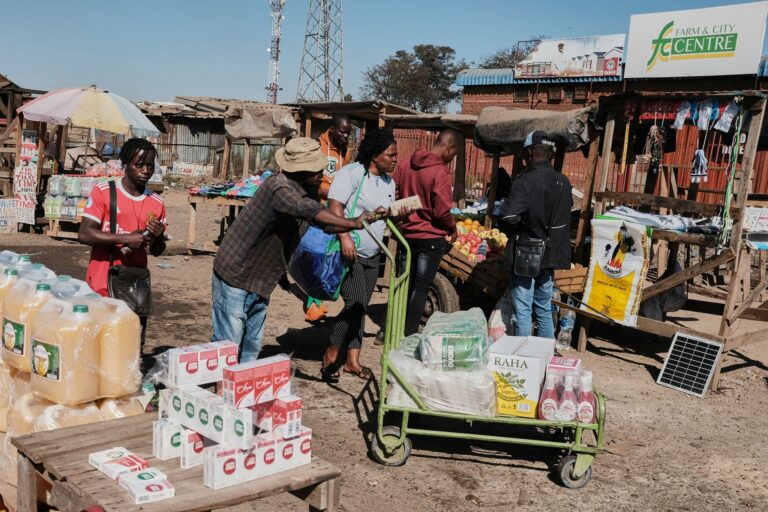
The informal economy now carries the weight of the country. Millions survive through vending, piecework and cross-border trade. These activities keep households alive but do not generate taxable revenue, productivity gains or sustainable development. An economy dominated by survivalism cannot grow in any meaningful sense.

There is also a dangerous political comfort in stability. A stagnant economy is easier to manage than a growing one. It creates fewer expectations, fewer demands and less pressure for reform. Stability becomes a tool for control rather than a stepping stone to progress.

This is where the distinction matters. Recovery implies momentum. Stability implies restraint. Zimbabwe has mistaken the absence of collapse for improvement.

Growth also requires trust. Businesses invest when contracts are enforceable, policies are predictable and institutions are independent. Without these foundations, capital stays away or remains short-term and extractive. Stability alone cannot compensate for institutional weakness.

The result is an economy trapped in a low-energy equilibrium. It is not falling apart at high speed, but it is not moving forward either. Young people see no future. Skilled workers leave. Those who remain adapt to survival, not ambition.

Zimbabwe does not need celebration of statistical calm. It needs honest recognition that stability is only the beginning, not the destination. Without deliberate efforts to restore growth, diversify production and rebuild confidence, stability simply becomes a holding pattern.

A country cannot spreadsheet its way out of poverty.
It must grow its way out.

Until growth returns, stability will remain what it currently is: a reassuring word masking a deeply uncomfortable reality.

Single-Digit Inflation, Mass Poverty: Zimbabwe’s Paper Economics Meets Hard Reality

0

Zimbabwe is being told to celebrate. According to the Zimbabwe National Statistics Agency, annual inflation has fallen to 4.1%, the lowest level recorded since the late 1990s. On paper, it is an extraordinary turnaround. On the ground, it is almost meaningless.

At a time when poverty is visibly deepening, households are shrinking meals, and informal survival has become the default economic model, claims of price stability feel detached from everyday life. This is not an emotional reaction. It is a credibility problem.

Inflation statistics do not exist in a vacuum. They are meant to describe lived economic conditions. When those conditions visibly contradict the numbers, scepticism is not only justified, it is necessary.

The official explanation is neat. Zimstat reports zero month-on-month inflation in January 2026 and sharp declines in both ZWG and USD inflation. Prices, according to the Consumer Price Index, have essentially stabilised. But stability relative to what baseline, and for whom?

Zimbabwe’s economy is not a normal, wage-based economy. Most people do not earn formal salaries adjusted annually or indexed to inflation. Income is irregular, informal and often declining in real terms. In such an environment, low inflation does not translate into affordability. It simply means prices are no longer rising as fast, not that people can afford them.

The poverty data quietly embedded in the same report tells a very different story.

Zimstat places the Food Poverty Line at ZWG 895 per person per month and the Total Consumption Poverty Line at ZWG 1,307. That figure represents the minimum income required not to be deemed poor. The question that immediately follows is obvious: how many Zimbabweans are earning that consistently, legally and in cash?

The answer is deeply uncomfortable.

What this exposes is the growing gap between macroeconomic presentation and social reality. Finance minister Mthuli Ncube has built his economic narrative around stabilisation, discipline and statistical improvement. In technical terms, he may even be correct. Inflation can be suppressed through currency controls, demand compression and restricted liquidity.

But suppression is not recovery.

Low inflation achieved by shrinking consumption, limiting money supply and pricing people out of markets is not economic success. It is economic paralysis. When people stop buying not because prices are fair but because incomes have collapsed, inflation falls by default.

That is not stability.
It is stagnation.

There is also a trust issue. Zimbabwe has a long history of statistical manipulation, selective measurement and methodological opacity. While Zimstat may not be fabricating figures outright, the assumptions behind the CPI basket, the weighting of goods, and the exclusion of informal market realities all shape outcomes in politically convenient ways.

Paper economics can always be made to look tidy. Real economies are messy, unequal and unforgiving.

If inflation were genuinely under control in a meaningful way, we would expect to see secondary indicators improve: reduced food insecurity, rising disposable income, declining informalisation and improved service delivery. None of these are happening at scale.

Instead, the economy remains survivalist. People are not budgeting. They are coping.

Zimbabwe does not suffer from a lack of statistics. It suffers from a lack of trust between numbers and experience. Until official data begins to reflect how people actually live, not how spreadsheets behave, claims of progress will continue to ring hollow.

Low inflation in a poor country is not automatically good news. Sometimes, it is simply evidence that the economy has stopped breathing.

And Zimbabweans can feel that far more clearly than any CPI chart suggests.

Gold tops $5,000 for first time ever, adding to historic rally

0

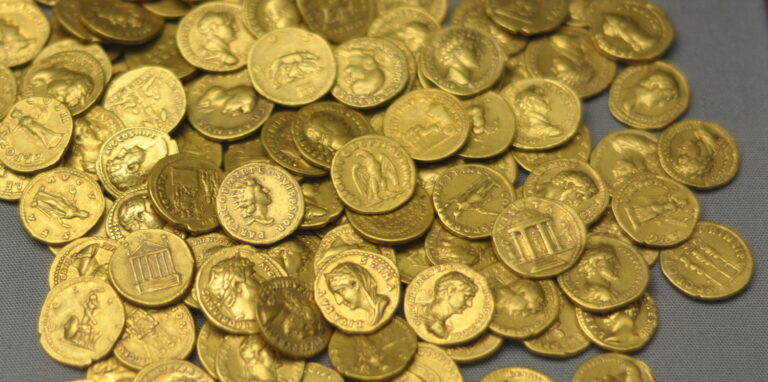
The price of gold has risen above $5,000 (£3,659) an ounce for the first time ever, extending a historic rally that saw the precious metal jump by more than 60% last year.

Gold’s value has soared as tensions heightened between the US and Nato over Greenland, adding to growing concerns about financial and geopolitical uncertainty.

US President Donald Trump’s trade policies also continue to worry markets.

While he last week withdrew import taxes on countries linked to the Greenland row, on Saturday he threatened to impose a 100% tariff on Canada if it strikes a trade deal with China.

Gold and other precious metals are seen as so-called safe-haven assets that investors buy in times of turmoil.

On Friday, silver topped $100 an ounce for the first time, building on its almost 150% rise last year.

Demand for precious metals has also been driven by a range of other factors including higher-than-usual inflation, a weak US dollar and buying by central banks around the world.

In addition, the US Federal Reserve is expected to cut interest rates again this year.

Wars in Ukraine and Gaza, as well as Washington seizing Venezuelan President Nicolás Maduro, have also fuelled the price of the precious metal.

One of the biggest appeals of gold is its relative scarcity. Only around 216,265 tonnes of the metal have ever been mined, according to the World Gold Council trade association.

That’s enough to fill between three to four Olympic-sized swimming pools. The majority of that was only extracted from the earth since 1950, as mining technology advanced and new deposits were discovered.

The US Geological Survey estimates that another 64,000 tonnes of gold can still be mined from underground reserves, although the supply is predicted to plateau in the coming years.

“When you own gold, it’s not attached to the debt of somebody else like a bond is or an equity where the performance of a company will drive performance,” said Nicholas Frappell, global head of institutional markets at ABC Refinery.

“It’s a really good diversifier in a very uncertain world,” he added.

“People go to gold”

Gold saw a blockbuster year in 2025, with its biggest annual gain since 1979 as investors flocked to precious metals.

With financial markets spooked by concerns including Trump’s tariffs and fears that artificial intelligence-related stocks are overpriced, gold repeatedly hit new record highs.

Susannah Streeter, chief investment strategist at Wealth Club, an investment platform for the wealthy, said gold “seems to know no bounds” amid ongoing political uncertainty.

“The pile on into the gilded safe haven is continuing with the precious metal racing up higher,” she said.

Streeter pointed to trade tension sparked by Trump’s tariff threat against Canada, saying it had “unnerved investors”.

While economic concerns can help push up the price of gold, it also tends to rise when investors expect interest rates to be cut.

Lower rates typically mean smaller returns for investments such as bonds, so investors look to assets like gold and silver.

The US Federal Reserve is widely expected to cut its main interest rate twice this year.

“It’s inversely correlated because the opportunity cost of keeping the money in a [government bond] is really not worth it anymore, so people go to gold,” said Ahmad Assiri, Research Strategist at Pepperstone.

It’s not just investors who have been buying up gold.

Last year, central banks added hundreds of tonnes of bullion to their reserves, according to the World Gold Council.

“There’s a very clear shift away from the US dollar, which is benefiting gold immensely,” said Kavalis.

The start of this year has seen gold continue to rally but Frappell warns the “news-driven” market could also result in a fall in its price.

“There’s got to be scope for unexpected news that actually might be positive for the world and not necessarily positive for gold,” he said.

But not everybody is buying gold for purely investment reasons.

In many cultures, the metal is purchased during festivals or given as gifts at celebrations such as weddings.

In India, the annual Diwali festival is believed to be an auspicious occasion to buy precious metals in order to bring on wealth and luck.

According to the US investment bank Morgan Stanley, Indian households held $3.8tn of gold, equivalent to 88.8% of the country’s gross domestic product (GDP).

Neighbouring China is the world’s largest single consumer market for gold, with many believing that buying it brings good fortune.

“We often see a seasonal uptick in demand around Chinese New Year, which we are seeing at the moment to an extent,” said Kavalis, referencing the upcoming Year of the Horse, which begins in February.

Source: BBC News

When America Does It, It’s “Law Enforcement”. When Africa Does It, It’s “Brutality”

0

Watching the immigration raids unfolding across the United States of America, and the brutal tactics being used by federal agents, it is impossible not to see uncomfortable historical parallels.

The language being used is familiar.
“We are taking our country back.”
“We are removing undesirables.”
“We are restoring order.”

These are not new political phrases. Zimbabweans have heard them before.

They echo the rhetoric used during Zimbabwe’s land seizures, when violence was justified as reclamation, when brutality was reframed as justice, and when dispossession was sold as patriotism. Different context, different actors, same logic: violence becomes morally acceptable when it is wrapped in the language of sovereignty.

But there is a crucial difference.

In Zimbabwe, much of the violence was carried out by war veterans and political militias. These were not disciplined state institutions. They were semi-autonomous groups that the state lost control over. Robert Mugabe did not command them so much as submit to them, because their loyalty was politically essential to his survival. The Zimbabwean state was weak, fragmented and incapable of restraining the forces it had unleashed.

That does not excuse the violence.
But it explains its structure.

What is happening in America is fundamentally different.

Here, the violence is not informal.
It is not chaotic.
It is not militia-driven.
It is not the product of state weakness.

It is state power itself.

Federal agents.
Formal chains of command.
Institutional authority.
Legal frameworks.
Operational planning.

This is not loss of control.
This is the controlled deployment of power.

And it is being justified openly by Donald Trump and his political ecosystem as “law enforcement”, “national security” and “border protection”.

If these same tactics were unfolding in Zimbabwe, the language in Western capitals would be immediate and unified. Sanctions. Condemnations. Emergency UN statements. Media outrage. Diplomatic pressure. Human rights investigations.

We have seen this script before.

After post-election violence in Zimbabwe, when soldiers shot protesters, sanctions were renewed. Western governments spoke of state brutality, abuse of power and repression. The moral framing was clear.

Yet now, in America, brutality is being normalised.

Human beings are treated as disposable.
Rights are subordinated to enforcement.
State violence is reframed as order.
Fear is rebranded as security.

And it is accepted.

Even more disturbing is the silence. Europe says nothing. Western governments say nothing. Institutions that normally speak loudly about human rights suddenly find their voices.

Not because the violence is less severe.
But because the state committing it is powerful.

This hypocrisy is not subtle. It is structural.

When Iran uses force to suppress unrest, the narrative is instant: dictatorship, repression, illegitimacy. When America uses force, the narrative shifts: stability, law, order, enforcement. Same methods. Same outcomes. Different labels.

The moral framework is not universal.
It is geopolitical.

That should worry everyone.

Because what is being normalised is not immigration control. It is the idea that state violence is acceptable when it is politically convenient, racially coded, and institutionally sanitised.

Zimbabwe’s violence was chaotic and uncontrolled.
America’s violence is bureaucratic and procedural.

That does not make it better.
It makes it more dangerous.

One reflects state weakness.
The other reflects state confidence.

And confidence in the use of force is always the most frightening form of power.

I do not know how this ends. But I do know this: when brutality becomes policy, when dehumanisation becomes governance, and when violence becomes normalised through legality, societies do not become safer.

They become colder.
More authoritarian.
More divided.
More fragile.

And history shows that once a state learns that violence can be justified, it rarely stops at its original targets.

Gold Lifts the Rand – But Zimbabwe’s ZIG Will Not Automatically Share the Gains

0

There was some rare good news out of the region this week as South Africa’s currency responded positively to record gold prices. The South Africa rand strengthened in early trade, edging closer to the psychologically important 16-to-the-dollar level, buoyed by a historic surge in gold and a softer US dollar.

According to Reuters, gold prices pushed above an extraordinary $5,000 an ounce as investors piled into safe-haven assets amid rising geopolitical uncertainty. For a commodity-linked currency like the rand, this matters. South Africa remains deeply exposed to gold, platinum and other metals, and when commodities rise while the dollar weakens, the rand tends to benefit.

Since the start of 2026, the rand has gained around three percent against the US dollar. That strength has been reinforced by expectations around the South African Reserve Bank’s first interest rate decision of the year. Markets are watching closely to see whether policymakers will use improved inflation dynamics to justify further easing after cutting rates by 25 basis points late last year.

On paper, this should also be encouraging news north of the Limpopo.

Zimbabwe introduced the ZIG currency with much fanfare, branding it as gold-backed and therefore insulated from the volatility that destroyed previous monetary experiments. In theory, rising gold prices should strengthen confidence in any currency anchored to bullion.

In practice, however, Zimbabwe is unlikely to benefit meaningfully from this rally.

The difference lies not in geology, but in governance.

South Africa’s rand may be volatile and vulnerable to global shocks, but it operates within a functioning institutional framework. The central bank is credible, policy signals are broadly coherent, and investors can at least price risk with some confidence. That credibility allows positive external shocks, such as surging gold prices, to feed through into the currency.

Zimbabwe lacks that transmission mechanism.

A gold-backed currency only works if the gold is verifiable, transparently managed and insulated from political interference. In Zimbabwe’s case, chronic economic mismanagement, opaque reserve disclosures and entrenched corruption undermine any theoretical benefit that higher gold prices might deliver. Markets do not reward narratives; they reward trust.

Even if gold prices soar, confidence in the ZIG will remain fragile as long as monetary policy is subordinated to short-term fiscal and political needs. Without discipline, gold backing becomes a slogan rather than an anchor.

There is also a broader regional reality to consider. South Africa benefits from scale, deep financial markets and integration into global capital flows. Zimbabwe remains isolated, cash-starved and policy-incoherent. External tailwinds that lift one economy do not automatically carry another, especially when institutional foundations are weak.

So while the rand’s response to record gold prices is genuinely positive news for South Africa, and an interesting signal for commodity-linked currencies globally, it should not be overinterpreted in Zimbabwean terms.

Gold can support a currency.
But it cannot compensate for broken trust, weak institutions and systemic corruption.

Until those fundamentals change, Zimbabwe will continue to watch regional gains from the sidelines, even when the numbers, on paper, appear to be in its favour.

Why ZANU PF Fears a Referendum More Than an Election

0

To outsiders, it may seem counter-intuitive. ZANU PF has manipulated elections for decades. Why, then, would it fear a referendum more than a general election?

The answer lies in control.

Elections in Zimbabwe are complex, multi-layered and easily disrupted. They can be delayed, re-run, challenged in court or neutralised through institutional capture. Voter apathy, logistical confusion and state dominance of the media all work in the ruling party’s favour.

A referendum is different.

A referendum is blunt. Binary. It strips away party branding and reduces the question to a single national choice. There are no parliamentary seats to distribute, no local power brokers to placate, no opposition candidates to fragment. Just a yes or no.

That simplicity terrifies ZANU PF.

Any attempt to amend the Constitution to extend presidential terms or reset succession rules would inevitably become a referendum on the party itself. It would not be about legal clauses or technical adjustments. It would be about trust, legitimacy and fatigue.

In a country exhausted by economic collapse, currency failures and elite excess, a referendum would mobilise discontent in a way elections often fail to do. Citizens who might stay home on polling day are far more likely to turn out to block something perceived as a power grab.

More importantly, a referendum creates a unified opposition front by default. There is no need for coalition negotiations, candidate selection or messaging discipline. Every disgruntled group, from civil society to churches to opposition supporters, can rally behind a single rejection.

This is why ZANU PF’s internal panic is so intense. The party knows it cannot afford a national moment of clarity. It survives through confusion, fragmentation and managed uncertainty.

With Chamisa back in the political arena, the risk multiplies. A referendum would give him a national platform without the usual electoral constraints. It would allow him to campaign not for office, but for restraint, legality and constitutionalism, messages that resonate far beyond party lines.

ZANU PF understands this. That is why talk of constitutional amendments is loud in rhetoric but thin on execution. The fear is not legal defeat. It is popular humiliation.

In many ways, a referendum would be the most honest political exercise Zimbabwe has seen in years. And that is precisely why the ruling party wants to avoid it.

For a party built on control rather than consent, a direct question to the people is the most dangerous gamble of all.

Chiwenga vs the Business Barons: Why Zimbabwe’s Generals Are Turning on the Tenderpreneurs

0

The growing tension inside ZANU PF is no longer just about succession. It is about control. And at the centre of this struggle sits Vice-President Constantino Chiwenga, increasingly positioned against a powerful class of politically connected business elites who have come to dominate the ruling party’s economic machinery.

For years, ZANU PF has operated on an uneasy alliance between the securocrats who seized power and the business figures who monetised it. That arrangement is now breaking down.

Chiwenga represents the old command structure: the military wing that believes political authority should ultimately rest with those who “liberated” and “secured” the state. The business elites represent something newer and more dangerous to that worldview: wealth without discipline, influence without ideology, and power without military pedigree.

Figures such as Kudakwashe Tagwirei, Wicknell Chivayo and Paul Tungwarara symbolise this shift. They are not merely beneficiaries of the system; they are increasingly shaping it. Through tenders, quasi-state programmes and proximity to the Presidency, they have blurred the line between party, state and private capital.

For the military establishment, this is an existential threat.

Chiwenga’s anti-corruption posturing is often dismissed as selective or self-serving, but it reflects a deeper anxiety. The generals fear being sidelined by men who command money rather than guns, patronage rather than troops. In a post-Mnangagwa future, wealth networks could outmanoeuvre military loyalty, especially if succession is decided through internal bargaining rather than force.

This explains why business figures are now being named, criticised and exposed in ways that would have been unthinkable a few years ago. The corruption dossiers, the public accusations, the sudden suspensions of empowerment programmes are not about morality. They are warnings.

The message from the securocrats is simple: you may be rich, but you are not untouchable.

At the same time, the business elites are not innocent bystanders. They have grown emboldened by proximity to power, speaking openly, funding factions and positioning themselves as kingmakers in the succession race. Their mistake has been assuming that money alone can neutralise the military wing.

Zimbabwe’s ruling party is now caught between two irreconcilable forces: guns that demand loyalty and capital that demands access. That conflict cannot be permanently managed. One side will eventually have to give.

What we are witnessing is not chaos. It is a struggle over who owns the state after Mnangagwa. And for the first time, the answer is no longer obvious.

ZANU PF Is Eating Itself Because Time Has Finally Caught Up

What is unfolding inside ZANU PF is no longer routine factionalism. This is not the familiar internal jostling that the party has historically managed, contained or weaponised. What we are witnessing instead is a party at a crossroads, running out of time, options and unifying authority.

Under Zimbabwe’s Constitution, elections must be held next year. If they are held as required, Emmerson Mnangagwa cannot stand again. That single fact is driving the current panic.

For all the noise about extending Mnangagwa’s rule to 2030, the reality is brutally simple: the logistics of such a manoeuvre are near impossible without tearing the party apart. Any attempt to amend the Constitution would require a referendum, a political gamble ZANU PF would be forced to fight in an environment far more hostile than in previous years.

With Nelson Chamisa back in the political limelight, a referendum would become a de facto vote on ZANU PF itself. That is not a battle the party can confidently win.

And therein lies the problem. ZANU PF has less than a year to either produce a consensus successor or fundamentally rewrite the rules of the game. It has neither the unity nor the credibility to do both.

This looming succession vacuum explains why factional fights are no longer being fought quietly in smoke-filled rooms, but openly, recklessly and through public platforms.

The most telling example is the recent move to clip the wings of President Mnangagwa’s special investment advisor for the United Arab Emirates, Paul Tungwarara. Tungwarara had turned the Presidential Economic Empowerment Revolving Fund rallies in Manicaland into a personal political stage, using them to launch extraordinary public attacks on his rivals.

Without naming him directly, Tungwarara accused Kudakwashe Tagwirei, the Sakunda Holdings owner and ZANU PF Central Committee member, of plotting to pressure Mnangagwa into firing Constantino Chiwenga and other senior officials.

These were not careless remarks. They were deliberate factional missiles, exposing just how deeply succession politics have poisoned internal relations. Tagwirei, once widely touted as a potential successor, is not the only ambitious figure. Others, including Christopher Mutsvangwa, are widely believed to harbour similar ambitions.

Tungwarara himself is understood to enjoy backing from Mutsvangwa, who publicly pledged support for his bid to enter the Central Committee, directly positioning him against Tagwirei. This was not coincidence; it was a declaration of alignment.

The party’s response was swift and revealing. National commissar Munyaradzi Machacha announced the suspension of the Presidential Economic Empowerment Revolving Fund, effectively shutting down Tungwarara’s political oxygen supply. The programme had become his megaphone, and its suspension is widely read within party circles as an attempt to de-escalate factional warfare by silencing one of its loudest combatants.

But the damage is already done.

Tungwarara’s name has previously appeared in a corruption dossier tabled by Vice-President Chiwenga before the Politburo. He was also reprimanded by Parliament for failing to deliver 10,000 boreholes under the Presidential Borehole Scheme. Like Tagwirei and Wicknell Chivayo, he represents the increasingly visible fusion of political power, state contracts and opaque patronage.

These figures are no longer operating quietly behind the scenes. They are now clashing in public because the centre can no longer hold.

This is the deeper story behind ZANU PF’s infighting. It is not simply about personalities or egos. It is about a ruling party that has reached the end of its succession model. Mnangagwa’s departure, whenever it comes, will not be orderly. There is no agreed heir, no uncontested process and no shared vision.

With constitutional deadlines approaching and political pressure rising, ZANU PF is being forced to confront a future it has long avoided planning for. The result is panic, exposure and open conflict.

For observers, the infighting is fascinating. For ZANU PF, it is dangerous. And for the country, it signals that the era of managed stability within the ruling party may finally be drawing to a close.

What looks like chaos is in fact something more revealing: a party realising, too late, that time is no longer on its side.

White Rhodies Indulge in Treason by Inviting Disgraced Trump to Re-Fight Zimbabwe’s Land Question

There is something profoundly disturbing about white Zimbabwean farmers appealing to a foreign power to intervene in Zimbabwe’s internal affairs. Whatever one’s views on land reform, governance or compensation, inviting an external government to pressure or interfere in a sovereign state is not advocacy. It is treasonous.

That this appeal is being directed at Donald Trump makes it even more grotesque.

Let me be clear. I despise ZANU PF. I believe it has ruined Zimbabwe economically, institutionally and morally. But our problems are ours to confront and resolve. Outsourcing domestic disputes to foreign governments is not resistance; it is regression.

The white farming lobby’s behaviour exposes something deeper than a concern for land or compensation. It reveals a lingering colonial mindset that still views Zimbabwe as a territory to be negotiated over by white power brokers, rather than a country governed by its own people, however flawed that governance may be.

These are not neutral actors seeking justice. They are individuals still trapped in a Rhodesian fantasy of entitlement, appealing to a fellow white supremacist figure in the hope that racial solidarity will succeed where democratic legitimacy failed.

If this were truly about land, alternatives exist. The United States has vast tracts of agricultural land, with entire farms abandoned or underutilised. No one is stopping them from farming there. Yet that option holds no appeal. Why?

Because what they mourn is not soil. It is power.

Zimbabwe, under ZANU PF, offers something the US does not: cheap, exploitable black labour, weak employment protections, minimal enforcement of workers’ rights and an informal economy that benefits those with capital and connections. That is the real loss being grieved, not hectares.

The hypocrisy is staggering. These same voices often lecture Zimbabweans about sovereignty, investment confidence and rule of law, yet have no issue begging a foreign politician to strong-arm a post-colonial state on their behalf. One cannot claim patriotism while lobbying for external coercion.

Trump, of course, is a fitting choice. A disgraced president with a track record of racial grievance politics, nostalgia for empire and contempt for African agency. The alignment is not accidental. It is ideological.

Zimbabwe’s land question is complex, painful and unresolved. Compensation, where legitimate, should be handled transparently and lawfully. But it must be resolved by Zimbabweans, through Zimbabwean institutions, under Zimbabwean authority. Anything else reopens colonial wounds rather than healing them.

If these actors truly cared about Zimbabwe, they would engage locally, honestly and without racial entitlement. Instead, they have chosen to internationalise grievance and invite interference, confirming what many have long suspected.

This was never just about land.

It was about losing a country they once believed belonged to them.