Home Blog Page 290

South Africa: Toddler killed by leopard in Kruger National Park

0

BY BBC

A two-year-old boy has been killed by a leopard in South Africa’s Kruger National Park.

The leopard managed to access a fenced off area of the park and grab the boy, who was the son of an employee.

Family members rushed the boy to hospital but he was pronounced dead on arrival.

The park said in a statement that such attacks were “very rare”, but rangers killed the leopard to “remove the danger”.

Ike Phaahla, a spokesman for the park, said the exact circumstances of the toddler’s death remained unclear.

He said that animals were naturally afraid of human beings and did not usually get close to them.

“In parks like the KNP predators do interact with tourists and staff and at times it may result in species like leopard getting habituated to people and losing their fear,” Mr Phaahla said.

Park visitors followed strict rules to stay safe from animals, such as locking gates and travelling in groups, he said, adding that a leopard would be “very brave” to attack a fully grown adult but might “take a chance with a child between two to six years old”.

Leopards can get into fenced off areas by climbing trees
He said that people visiting and working in the park were given as much protection as possible with accommodation fenced off to keep animals out, but said they found ways of getting in.

“We have to respect that they are wild animals,” he said.

The Chief Executive Officer of South African National Parks, Fundisile Mketeni offered “prayers and thoughts” to the child’s family.

“This is the risk we live with on a daily basis as we help conserve our species for the benefit of all,” he said.

Focused Augusto targets Golden Boot

0

The Castle Lager Premier Soccer League’s man-of-the-moment, striker Clive Augusto is in no hurry to make any moves outside the country, saying he is focused on winning the Golden Boot and help the GameCocks clinch the championship this year.

BY FORTUNE MBELE

The 24-year-old has scored in each of the eight games that Chicken Inn have won and at the weekend, he dismantled Caps United at the National Sports Stadium with a treble.

He took his tally to 11 goals in 10 matches and expectations are high that South African clubs will start sniffing around.

The former Ngezi Platinum Stars forward said he had reached one of his targets, which was to hit double figures and now wants to win the Golden Boot.

“My target has always been a double-digit. I am glad I have already done that, but I want to remain focused and score more goals for Chicken Inn. I want to be among the Soccer Stars of the Year and win the Golden Boot this year and I think that is achievable,” Augusto said.

He said it’s his dream to play outside the country, but he thinks he is not yet ready for such a move.

“Every football player has ambitions of playing abroad and for me, I want to play in France, but I don’t think I am ready for that now. I just want to concentrate on playing locally and building my career until I am mature enough,” he said.

Chicken Inn has exported a number of players, but on Augusto, club secretary Tavengwa Hara said they would take their time.

“This time, we are going to take a different direction. Enquiries might come as is expected, but we have not received any. We will tell him (Augusto) to be patient. Recently, strikers who have gone outside the country, especially to South Africa, have struggled and it is our feeling that they have been hurried. We want to be very careful about his career,” he said.

Bantu Rovers’ Bukhosi Sibanda left the country mid-way through the season in 2017 with 10 goals from 14 starts to join Ubuntu Cape Town FC in the First National Division in South Africa.

Highlanders’ Prince Dube also left in the same year for SuperSport in the Absa Premier Soccer League.

Both players struggled and returned home to Highlanders, while last year’s Soccer Star of the Year and Golden Boot winner, Rodwell Chinyengetere, formerly with FC Platinum, is yet to find his feet at Baroka FC in South Africa.

Chavhanga hails South Africa tour

0

FORMER Springbok wing Tonderai Chavhanga has expressed his gratitude to the sponsors of the Zimbabwe Academy side for their support to the team during their participation in the SuperSport Rugby Challenge in South Africa, describing the team’s training camp in Cape Town as one of the best local players have ever experienced in their careers.

BY DANIEL NHAKANISO IN CAPE TOWN

The Zimbabwean team, nicknamed Young Bucks, has been based in Cape Town for the last six weeks, using False Bay Rugby Club as their training base during their participation in South Africa’s tier two competition.

The Zimbabwe Rugby Union, in collaboration with the Sables Trust, headed by newly-appointed Sports and Recreation Commission board chairman Gerald Mlotshwa, has ensured that the team is catered for after roping in a strong line-up of sponsors to bankroll the team’s participation in the highly-competitive tourney.

The main sponsors of the Zimbabwe Academy side are international mining investment company Zerttew Resources, along with South African commodities and energy trading company Portnex International and Zimbabwean attorney firm Titan Law.

International sports brand BLK is the official kit sponsor.

Chavhanga has been impressed by how the South African training camp and participation in the SuperSport Rugby Challenge has impacted on local players.

“We’ve been very fortunate, from a sponsorship point of view. I think Zerttew, Titan Law and Portnex International have been phenomenal in making sure that the team is adequately taken care of,” Chavhanga said.

“You can see from the place where we are staying, it’s been absolutely amazing. All the guys in this camp have certainly said that this is the best camp that they’ve ever been in and the fact that we’ve had one base and everything pretty close to us,” he said.

The former Free State Cheetahs, Stormers, Western Province, Golden Lions, Sharks and Welsh side Newport Gwent Dragons wing said he was hopeful that similar training camps would be held for the team ahead of other international matches.

“The biggest challenge that we face is that if you look at the composition of this team, the majority of the guys are playing all over. So, in the past when we were preparing for tournaments, we had about three or four days to prepare for the games. In the future, it would be great if we could get more time to get the team together and make sure that everybody is on the same wave length,” he said.

“Obviously having had the guys for the last six, seven weeks we’ve got a nice foundation and going forward it’s going to be somewhat a lot easier.”

Warriors fall to Chipolopolo

0

ZIMBABWE…..0

ZAMBIA…….0

(Zambia won 4-2 on penalties)

Khama Billiat and Admiral Muskwe both missed from the spot during a semi-final penalty shootout against Zambia, with the Warriors Cosafa Cup title defence attempt ending in disappointment at the Moses Mabhida Stadium last night.

BY HENRY MHARA IN DURBAN, SOUTH AFRICA

Billiat slipped and scuffed his shot which was saved by the goalkeeper Sebastian Mwange, while Muskwe skied his effort and Zimbabwe never recovered.

Marvellous Nakamba and Tendayi Darikwa converted their spotkicks, but it was not enough for Zimbabwe as Zambia were clinical, scoring all four of their penalty kicks.

The match had ended goalless after 90 minutes, with Warriors goalkeeper Elvis Chipezeze saving a penalty in regulation time.

The Warriors will now play Lesotho in a third and fourth play-off on Friday, while Zambia meet Botswana in the final the following day.

Zimbabwe, without coach Sunday Chidzambga who had to abort the tournament following the passing on of his father, dominated proceedings for the larger part of the match.

They could have gone in front in the 12th minute, but Muskwe failed to connect a cross from Devine Lunga after good interchanges, while Thabani Kamusoko’s effort was saved.

At the other end, Chipezeze made two blocks in quick succession in the first half.

At this point, Zambia were beginning to see much of the ball, but couldn’t make full use of their possession.

Skipper Musona had been anonymous so far by his huge standards, but burst to life on the 38th minute when he roasted his marker twice before he was hacked down inside the box as he prepared to open fire.

Comoros referee Ali Adelaid ignored the appeals from the Zimbabwe team. A minute later, he pointed to the spot at the other end for an infringement inside the box.

Austin Muwowo took responsibility, but Chipezeze stretched to his right and blocked the penalty kick.
The start of the second half was a balanced affair, and Gumbo decided to shake things up by bringing on Billiat just after the hour mark, whose introduction was greeted by a huge roar inside the stadium.
Immediately, the Warriors seized control of the match, and should have gone in front on 66th minute when Musona beat his marker and took aim at goal, but his shot was pushed around the post by the goalkeeper.
Zambia sat back for the remainder of the game as they denied Zimbabwe space, but their defence was opened up by Billiat, crossing for substitute Tino Kadewere, who inexplicably curled his shot wide from inside the box in the referee’s optional time.

The missed chance proved to be the last major highlight of the match, and a penalty shoot-out to decide the team to progress to the finals on Saturday, ensued.

Teams

Zimbabwe: E Chipezeze, T Darikwa, D Lunga, A Mudimu, T Hadebe, M Munetsi (M Nakamba, 85’), T Kamusoko, T Chawapiwa (T Kadewere, 85’), T Kutinyu (K Billiat, 61’), K Musona, A Muskwe

Zambia: S Mwange, A Chama, L Kambole (E Chabula, 87’), B Sakala, E Mbewe (B Musakanya, 90’), A Muwowo (W Muzaza, 57’), T Kaseba, T Mwape, J Chirwa, C Mulashi, M Phiri

German ex-nurse convicted of killing 85 patients

0

BY BBC

A former nurse has been convicted of murdering 85 patients at two hospitals in northern Germany and handed a life sentence.

Judge Sebastian Buehrmann described Niels Högel’s killing spree as “incomprehensible”.

Högel, who is already serving life for two murders, administered lethal doses of heart medication to people in his care between 1999 and 2005.

He is believed to be the most prolific killer in Germany’s modern history.

Prosecutors said he attacked patients in order to impress colleagues by subsequently trying to revive them.

A former colleague told the German newspaper Bild that Högel was nicknamed “resuscitation Rambo” because of the way he “pushed everyone else aside” when patients needed to be resuscitated.

On the last day of his trial, Högel, 42, asked the families of his victims for forgiveness for his “horrible acts”.

“I would like to sincerely apologise for everything I did to you over the course of years,” he said.

Högel had been accused of murdering 100 patients in the northern cities of Delmenhorst and Oldenburg. Police believe he may have killed far more but the cremation of bodies had destroyed any possible evidence.

Högel had confessed to 55 murders and the court in Oldenburg convicted him of 85, German media reported.

Delivering sentence, Judge Buehrmann expressed regret that the court had not been able to “lift the fog” for many grieving relatives.

The BBC’s Jenny Hill in Berlin says the case has shocked Germany – not least because senior staff at the two hospitals are accused of having turned a blind eye to unusually high mortality rates.

Högel’s killing spree was stopped when he was caught in the act of administering unprescribed medication to a patient in 2005 in Delmenhorst. He was sentenced to seven years for attempted murder in 2008, but the families of his other suspected victims pressed for a further investigation.

At a second trial that ended in 2015 he was jailed for life for two murders and two attempted murders.

However, during that trial he confessed to a psychiatrist that he had killed up to 30 people.

Investigators then widened the investigation, exhuming 130 former patients and looking for evidence of medication that could have triggered cardiac arrest. They also pored over records in the hospitals he worked at.

Records at the Oldenburg hospital showed rates of deaths and resuscitations had more than doubled when Högel was on shift, German media said.

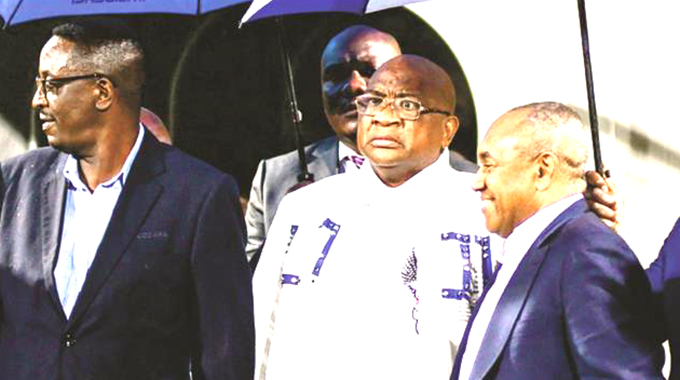
Confederation of African Football: President Ahmad detained in France

0

BY BBC

Fifa has confirmed that the Confederation of African Football President Ahmad is being questioned by authorities in France.

A statement from football’s world governing body says it is “in relation to allegations related to his mandate while President of Caf.”

It added that “Fifa is unaware of the details surrounding this investigation and is therefore not in a position to make any comment on it specifically.

“Fifa is asking the French authorities for any information that might be relevant to investigations taking place within its Ethics Committee.”

South African rand falls to its lowest in 2019

0

BY AFRICANEWS

South Africa’s rand fell early on Thursday to its lowest this year.

This comes as a dispute within in the ruling African National Congress over the central bank weakened demand.

At 0800 GMT, the rand was 0.15% weaker at 14.8850 per dollar compared with an overnight close of 14.8600.

It tumbled to a session low of 14.9625, its weakest since October, before settling near 14.80.

The currency has been hurt by the ANC’s internal squabble over whether the central bank should do more to promote jobs and growth .

That worsened the damage done by data showing the economy shrank by 3.2% in the first quarter.

Bonds opened weaker, with the yield on the benchmark 10-year issue up 2.5 basis points to 8.475%.

CAF boss’ arrest in Paris throws 2019 AFCON finals into turmoil

0

EXACTLY two weeks before the 2019 AFCON finals burst into life in Cairo, Egypt, African football has been shocked to its foundations by the arrest after its leader, Ahmad Ahmad, was arrested at a luxury Parisian hotel in France yesterday on corruption charges.

The 59-year-old Ahmad, who rose to power riding on a wave of popular support that toppled the long-serving Issa Hayatou two years ago, has seen his reign being marred, in recent months, by allegations of corruption, abuse of office and claims he could have sexually harassed four female CAF employees.

He was forced to fire the CAF secretary-general, Amr Fahmy, when it was revealed the Egyptian had turned into a whistleblower and compiled a dossier, which was sent to the FIFA Ethics Committee, detailing the way Ahmad had been abusing his position, including but not limited to, pursuing projects that would benefit him financially.

Ahmad was also accused of over-spending more than US$400 000, according to an internal document sent by Fahmy to the FIFA Ethics committee, on cars in Egypt and Madagascar, where a satellite office had been set up for him. Fahmy was replaced by Mouad Hajji, from Morocco, and there have been concerns around the continent, of late, that Ahmad appears to have been sucked into the pockets of the powerful North African country and now always seemed to be dancing to their tune.

South African Football Association boss Danny Jordaan’s surprise loss to his Malawian counterpart, Walter Nyamilandu, in the vote for the FIFA Council seat last year, despite the former’s excellent work in organising Africa’s first World Cup finals in 2010, was also linked to the Moroccan influence.

Jordaan, just like his Zimbabwean counterpart, Philip Chiyangwa, fell out with Ahmad, and his Moroccan associates, after the duo backed the Americans’ successful bid to host the 2026 World Cup rather than throw their weight behind the North African country.

Although both Jordaan and Chiyangwa played a very influential role in Ahmad’s rise to become the CAF president, the former Madagascar football leader chose to turn his back on them, after he assumed office, and started enjoying the company, and patronage, of the North Africans.

Last week, the two parties appeared to patch their differences when Ahmad made a surprise visit to the COSAFA Cup in Durban, with the regional leaders issuing a statement to support him, but many seasoned observers dismissed it as a public relations gimmick.

FIFA confirmed yesterday, in a statement released after Ahmad’s arrest at the Berri hotel in Paris by French authorities, that the CAF president, who is also the FIFA vice-president by virtue of his position in African football, was being investigated by their Ethics Committee.

An Egyptian media outlet said Ahmad was detained because of a case in which German sportswear firm, Puma, complained it was elbowed out of a deal it had signed with CAF worth US$312 000, with Ahmad allegedly playing a key role in the cancelling of the deal, saying he wanted Adidas to supply the equipment. Puma are said to have asked for US$105 000 as a penalty for the cancellation of the deal, which Ahmad allegedly refused to pay, and a few months later, CAF entered into an agreement with Tactical Steel for the provision of the same equipment at the cost of US$1.2 million.

There had been indications that all was not well for Ahmad after FIFA president Gianni Infantino, who came to power on the promise he would clean a house that was almost brought down by the corruption scandals which swept away former president Sepp Blatter, cancelled his participation in the 2019 AFCON draw in Cairo in April.

Zimbabwe’s Warriors were drawn against the Pharaohs of the host country, Egypt, to open the 24-team tournament in Cairo on June 21.

Interestingly, if Ahmad remains detained or is asked to step aside, for now, Nigeria’s Amaju Pinnick, whose organisation is hosting the Warriors at a high-profile international friendly tomorrow, will take over as acting CAF boss.

‘’FIFA has taken note of the events concerning Mr Ahmad Ahmad, who is being questioned by the French authorities in relation to allegations related to his mandate while President of CAF,’’ FIFA said in a statement.

‘’FIFA is unaware of the details surrounding this investigation and is therefore not in a position to make any comment on it specifically.

FIFA is asking the French authorities for any information that might be relevant to investigations taking place within its Ethics Committee.

‘’As a matter of due process, everyone has the right to the presumption of innocence, but as the FIFA president reiterated yesterday, FIFA is fully committed to eradicating all forms of wrongdoing at any level in football.

‘’Anyone found to have committed illicit or illegal acts has no place in football.

‘’FIFA is now clean from the scandals that tarnished its reputation and this same determination should prevail in governing bodies such as confederations. FIFA will be at the forefront of ensuring that this is enforced by everyone involved in football.’’

Ahmad was also flagged in the bloodbath, which has been looming for some time in African football corridors of power amid fears that some of the continental game’s heavyweights could face the music from FIFA as part of a brutal and widespread crackdown on the corruption orchestrated by banished former Qatari strongman Mohamed Bin Hammam.

At least 25 former and current African football leaders have been under the spotlight, for all the wrong reasons, after it emerged that their files, in which they received illicit funds from Bin Hammam, have not been closed.

Former African Footballer of the Year, Kalusha Bwalya, has already served his punishment after he was banned for receiving funds from Bin Hammam.

Ahmad also received cash from Hammam.

Complaints have been filed against him in Morocco, Paris and London with the CAF boss being accused of claiming almost US$18 000 in expenses from CAF for air travel and daily allowances for last year’s World Cup, despite it being a FIFA tournament which had nothing to do with CAF having to fund it.

FIFA footed the bill for Ahmad’s travel, accommodation and related costs, including a generous daily allowance, because of his role as the vice-president of the organisation.

“Nonviolence is a basic human right” CANVAS

0

BY RUVIMBO MUCHENJE

The Center for Applied Non-Violent Action and Strategies (CANVAS) has released a statement denouncing the recent arrests of participants that attended their workshop in Maldives recently.

George Makoni, Nyasha Frank Mpahlo, Tatenda Mombeyarara, Gamuchirai Mukura, Farirai Gumbonzvanda, Stabile Dewa, and Rita Nyampinga have been arrested on subversion charges after attending a training organised by CANVAS “to topple the incumbent government.”

In the statement, CANVAS decried the abuse of human rights saying the arrests are illegal.

“The Center for Applied Non-Violent Action and Strategies (CANVAS) firmly condemns the illegal arrest of seven (7) Zimbabwean civil society activists on their way home from attending a training workshop organized by CANVAS in the Maldives from May 15 to 19, 2019,” they said.

The detainees have been denied bail so far with six remanded in prison and the seventh, Gamuchirai Mukura, remanded in a public hospital.

During the workshop, the State-controlled newspaper, The Herald, published an article that alleging the detainees of plotting to unseat the constitutionally government.

CANVAS denies the charges levelled against it of training the seven to topple theZANUPF government.

“CANVAS would like to inform Zimbabweans and the international community that the charges against these activists are blatantly false. The charges include: “subversion”, “counterintelligence”, and “being trained in use of small arms”. The activists could face up to twenty years in prison for these charges. The workshop focused on advocacy and civic engagement capacity building such as: Developing Shared Vision of Tomorrow; Civic Engagement; Effective Communications; Protecting Privacy and Security; and Organizational Planning,” they said.

The organisation is calling on the government to immediately release the seven activists.

“CANVAS calls on the Government of Zimbabwe to immediately and unconditionally release the seven (7) activists and follow the rule of law,” said CANVAS.

Get full statement here

Foreign aid dreadful, unnecessary!

0

ZIMBABWE does not need foreign aid to escape this economic malaise. Our leaders have been saying it so many times that the country’s hope lies on a bailout package; the quicker we get it, the better, but this is a misplaced sentiment. The country has lost so much time and resources hunting for bilateral aid, which is not necessary anyway, instead we should focus more on finding solutions to our current problems with what we already have.

Though developmental economist and prominent author, Jeffrey Sachs, vehemently argued that less developing nations are faced with what he termed poverty traps and need a bailout package in the form of official development assistance in order to escape extreme poverty but I, together with other economists like Dambisa Moyo and William Easterly, believe that developmental aid is the reason why we are poor today.

Internal efforts to alleviate poverty have been a failure for the past five decades despite the West’s effort, having spent more than $2,3 trillion, but still 1,1 billion people still live in extreme poverty.

Those countries that have rejected the aid route have prospered while countries like Zimbabwe have become aid-dependent and seen poverty increasing. Over-reliance on aid has trapped developing nations in a vicious cycle of aid dependency, corruption, market distortions and further poverty, leaving us with nothing, but the need for more aid.

Moyo argued that over the past 30 years, the most aid-dependent countries have exhibited growth rates averaging minus 0,2% and when aid flows were at their peak between 1970 and 1998, poverty in Africa rose to a staggering 66%.
Ovaska (2003) empirically demonstrated that decreasing the level of developmental aid may actually have a beneficial effect on growth. He found that a 1% rise in aid as a percentage of GDP decreases annual GDP per capita growth by 3,65%. Aid incentivises citizens of poor nations to be dependent and unproductive, which ultimately harms their economic progress.

Aid is corrosive, according to Moyo, in that it encourages exceptionally talented people to become unprincipled, putting their efforts into attracting and siphoning of aid rather than focussing on being good politicians or entrepreneurs. A foreign aid environment weakens social capital by thwarting accountability mechanisms, encouraging rent-seeking behaviour, siphoning of scarce talent from employment positions and removing pressures to reform inefficient policies and institutions.

Zimbabwe has been receiving aid and some form of bailout packages for the past 29 years, yet the economic situation is worsening, and poverty rates increasing. The failure of our country’s economy is not the lack of aid or of inadequate finance, but its more to do with its governance and institutions around. It’s about politics.
Poverty is not a technical problem, according to Easterly, it is a social problem that is caused by social causes of poverty, bad institutions, bad politics, misguided policies, trading networks that exclude the poor, high transaction costs in markets and ineffectual aid donors.

Caden (2009) wrote that economic development is an institutional rather than an infrastructural and technological problem. People respond to incentives, and institutions defining those incentives have fundamental implications.
The ideas to end poverty are better learnt from Adam Smith (1776). Nations become wealthy as the scope of the market expands and their citizens are increasingly able to take advantage of the division of labour and this points out to the fact that nations that lack proper property rights, which do not enforce contracts inhibit the creation of wealth, hence will remain poor, Zimbabwe being one of them.

The success stories of India, South Korea and China are not from these kinds of bailout packages that Zimbabwe is seeking for; they are from market liberalisation and entrepreneurship. Zimbabwe’s failure is not caused by lack of foreign aid, presence of sanctions, ignorance or lack of resources, but rather, it is a result of selfish interest of the dictators to amass wealth through extractive institutions at the expense of the majority. South Africa is doing well. Botswana is one of the growth miracle countries and these are all our neighbouring countries. So it is not like our leaders are ignorant and can’t see and copy from nearby, but the presence of corruption, absence of rule of law, misgovernance, no property rights and enforceable contracts would maximise the elite’s rent-seeking activities.

Those in this bad system or linked to it are benefiting and they do not dare complain. That is why you hear them justifying corrupt tendencies, luxurious and wasteful globe-trotting trips at the expense of drugless hospitals and protection of shortage-creating fuel cartels. There is liquidity crisis in Zimbabwe and most commercial banks stopped cash withdrawals a long time ago, but money changers are in the streets with thousands of this scarce and most hunted RTGS notes, then you wonder who their supplier is. Who are the major shareholders of all these remaining companies, mining firms, and owners of major gold claims, among others? Obviously, it’s not that poor peasant farmer of Uzumba, Buhera or Gokwe, it’s those same politicians.

So if you say an economic crisis is looming, there is extreme poverty in Zimbabwe, hospitals are now in a bad state, schools are now offering the worst kind of education ever due the lack of incentives and motivation to the facilitators, who cares, who hears? Their children learn abroad. If they fell ill, they are flown abroad to India to get the best medication and attention ever. They are equally more important and you are just inferior, no matter how you cry, talk or shout. The incentive or push to make things straight is none existent, because extreme poverty is in your homes, not in theirs.

Do they use public transport, RTGS dollars, earn peanuts like the majority of civil servants, or sleep in fuel queues? Do they do shopping here in Zimbabwe? No, they don’t. So why should they make the system straight if their problems are not the same as ours? Zimbabwe has all it needs to prosper; natural resources, human resources among others; bad institutions are the binding constraints, corruption, expropriation of property, misgovernace, absence of the rule of law, lack of contract enforcement, repressed markets and poor policies, just to mention a few. Zimbabwe does not need aid, it needs sanity!

 Blessing Machiva is a developmental economist and he writes in his personal capacity.