

By Samuel Musarika
For decades, the word “irreversible” was the cornerstone of Zimbabwe’s land reform politics. It was used as a shield against international criticism, a rallying cry for sovereignty, and a warning to anyone who questioned the legality or consequences of the land seizures that began in 2000. Yet in May 2026, Agriculture Minister Anxious Masuka was forced to clarify a position that now looks increasingly difficult to defend: if land can be returned, restored, sold back or compensated for, then “irreversible” no longer means what ZANU PF spent two decades telling Zimbabweans it meant.
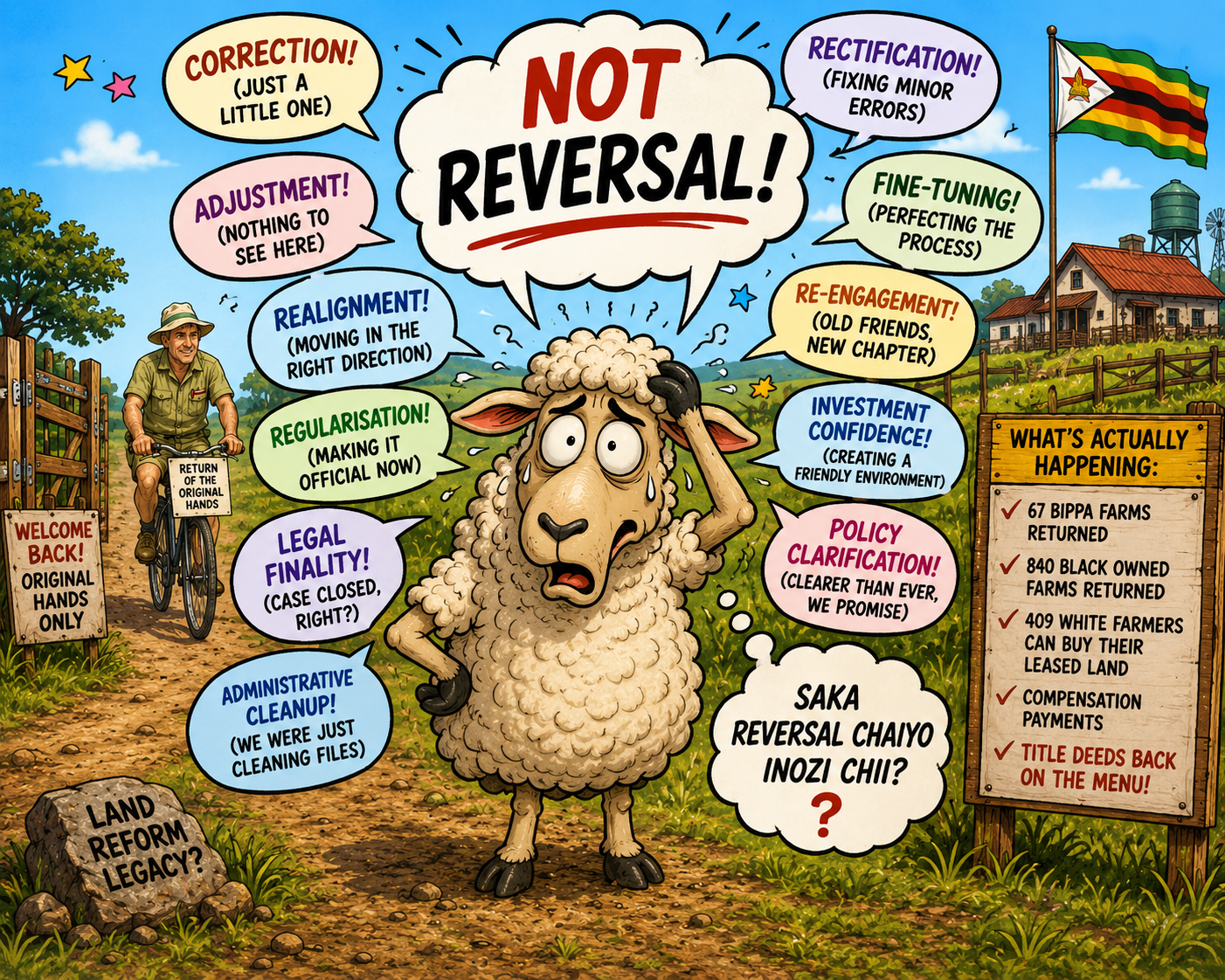
The government insists that this is not a reversal of land reform. It says critics and international media have misunderstood the issue. But the government’s own figures tell a different story. According to its clarification, 840 farms belonging to indigenous Zimbabweans that were wrongly gazetted will be returned to their owners. Sixty seven BIPPA protected farms, which had remained unoccupied, will be returned to foreign investors. A further 409 former white farm owners who are peacefully coexisting with beneficiaries will be allowed to purchase their farms, or portions of them, through a set off mechanism for investments due for compensation. That is not a minor clerical tidy up. It is a major retreat from the old doctrine of finality.
The BIPPA issue is especially revealing. For years, Zimbabwe argued that domestic land reform laws and sovereignty took precedence over international claims. Yet Reuters reported that the 67 farms being returned are linked to nationals from Denmark, Switzerland, Germany and the Netherlands, and that the move forms part of Zimbabwe’s attempt to mend ties with Western countries while seeking debt relief. Reuters also reported that Zimbabwe’s foreign debt stood at US$13.6 billion in September 2025, with US$7.7 billion in arrears. In other words, this is not happening in a vacuum. It is happening because international isolation has become too expensive.
The 409 former white farmers present another contradiction. If former owners are now permitted to buy the land they occupy, even partially, then the state is no longer simply defending the original revolutionary settlement. It is rebuilding private property rights in areas where they were politically denounced for years. The same government that once treated such claims as hostile to land reform is now presenting their resolution as “legal finality”. That may be useful language for creditors, diplomats and investors, but ordinary Zimbabweans are entitled to call it what it is: a U turn in selected areas.
The 840 black owned farms also expose the weakness of the “correction” argument. If hundreds of indigenous farms were wrongly gazetted during the land reform process, then the government is admitting that the programme did not merely correct colonial injustice. It also created new injustices. Calling those seizures “administrative errors” may soften the political embarrassment, but it does not erase the fact that real owners lost real property through a process the state now accepts must be undone.
This does not mean the whole land reform programme has been cancelled. That is not the argument. The argument is more precise: ZANU PF is reversing specific legal, political and economic positions it previously defended as untouchable. It is returning some land. It is restoring some wrongly seized farms. It is allowing some former white farmers to purchase land. It is compensating some claimants. It is issuing new forms of tenure to resettled farmers. Even the 2024 title deed policy for resettled farmers was described as a major shift because beneficiaries previously could not freely transfer ownership or use land as bankable collateral in the same way.
The real driver is not moral awakening. It is survival. Zimbabwe has spent more than two decades largely shut out of the global financial system. Creditors and international lenders have repeatedly linked debt progress to reforms, including the resolution of land disputes. The US$3.5 billion compensation agreement with former white farmers, the return of BIPPA farms and the renewed emphasis on property rights all point in the same direction: the government is trying to buy its way back into respectability after years of insisting that sovereignty alone was enough.
So, when Minister Masuka says land reform remains irreversible, he is relying on a political slogan that no longer fits the evidence. You cannot return land that was “irreversibly” taken and then pretend nothing has reversed. You cannot allow former owners to buy back land and call it mere clarification. You cannot restore 840 wrongly seized farms and pretend the original process was beyond question.
The media is not being mischievous by calling this a reversal. It is simply refusing to launder government language. If it looks like a reversal, acts like a reversal, costs billions to settle and is being done to unlock international confidence, then it is a reversal. The only thing still irreversible is ZANU PF’s habit of renaming retreat as correction.
