Home Blog Page 93

Rural teachers turn to JOC over abuses

0

BY BRENNA MATENDERE

AMALGAMATED Rural Teachers Union of Zimbabwe (Artuz) has resolved to engage the Joint Operations Command (JOC) to seek protection of its members in remote areas, who are allegedly facing harassment and intimidation from suspected State security agents.

The resolution was made at the union’s congress, which ended on Friday in Gweru.

Part of the resolution reads: “Union will engage the Joint Operations Command (JOC) to lobby them to stop the victimisation of teachers. Artuz will run its Safe Schools Campaign with special focus on litigation and advocacy. Teachers to actively work as human rights defenders, defending their labour rights and the right to education for the learners.”

Artuz president Obert Masaraure yesterday told NewsDy that their leadership would meet JOC at national level.

“We will meet them at national level to explain our ideological stand point and what we seek to achieve. Our security sector is constituted by civil servants like ourselves. We are confident that if we engage we can find common ground,” he said.

“Our politicians are notorious for turning workers against each other. That must end. Our State security should protect the broader interests of the State, not private interests of individual politicians.”

Artuz last year reported that its members in rural areas were facing intimidation from suspected State security agents after they had declared incapacitation and stopped reporting for duty.

The union also resolved that its members would not report for work when schools open tomorrow citing incapacitation.

Meanwhile, Masaraure was given a fresh mandate as the Artuz president after being elected uncontested.

The same happened to the union’s secretary-general, Robson Chere.

Poor debates by MPs, councillors rile Chamisa

0

BY BLESSED MHLANGA

OPPOSITION MDC leader Nelson Chamisa, unhappy with the quality of debate in Parliament and the level of leadership in the country, has called on the electorate to use the 2023 elections to elect competent representatives who will effectively articulate their aspirations.

“I am also worried about the quality of debate (in Parliament) at times, but a representative can only be a representative of those represented, so to the extent that people go there (to Parliament) and do things that are below the standard and there is no questioning, there is no accountability, it says something about the quality of citizens in Zimbabwe. We must do more. It’s a reflection, I mean, your leadership reflects yourself. Just think about your leadership, it’s a reflection of who you are,” Chamisa said.

The House of Assembly has 270 seats, with 210 directly elected from constituencies, and 60 reserved for women on a proportional representative base, but having less than 20 active legislators contributing to debates.

Chamisa told NewsDay that there was need to have a critical citizen who would refuse to be represented by an unaccountable and substandard leadership.

“We must send better representatives (to Parliament), but this has to do with us being critical of our representatives, (but) in this space, we don’t question leaders. In this country, you go for ages without electricity and not a single person comes to say I am sorry, yet there is a person who is in charge of that,” he said.

“Roads are in a dilapidated state, yet nobody will come to you and say we are sorry. This is the challenge. We will do our best. (There is) no accountability. In a normal country, if you have a cent increase in fuel, there will be pandemonium, hullabaloo, but here, the country goes in any direction and we adjust.”

Zimbabwe is facing critical shortages of water, cash, electricity and fuel as the economy tanks, eroding savings and disposable income, and Chamisa said because of a timid society that allows leadership off the hook easily, things would continue to get worse.

“First, there was no water and we had to drill boreholes. We realised the boreholes were not enough and we had to do tanks. We realised tanks are not enough, we now have our own methods of buying water. There is no electricity (and) what do we do? Let’s have generators; generators are not helping, lets go solar; solar is not helping us, let’s go firewood,” he said.

“Our teachers should teach people to ask leaders questions so that they are responsible and accountable. The teacher is not teaching pupils to be critical because being critical is punished, being critical invites death, but teachers must teach us to be more critical and ask relevant questions as citizens.”

Unions plot mega shutdown

0

BY BLESSED MHLANGA/BRENNA MATENDERE

ZIMBABWE is on the verge of a complete shutdown as private and public sector workers as well as college students plan to take to the streets.
Teachers, lecturers and students are planning to coalesce with the rest of the civil service for a strike that could cripple essential services and the start of the school calendar tomorrow.

Government workers last week rejected an offer by government to double their wages and the Zimbabwe Congress of Trade Unions (ZCTU) is planning “mother-of-all” demonstrations to press government to address key national issues and reverse “anti-poor people policies”.

The 97% salary hike would have seen the lowest paid government worker getting
$2 033.

But the civil servants demanded that their salaries to be indexed to the United States dollar equivalent to those they earned during dollarisation period.

Alternatively, the Progressive Teachers Union of Zimbabwe (PTUZ), Zimbabwe
Teachers Association and Zimbabwe National Students Union (Zinasu) as well as the rest of the civil servants are pressing government to raise wages to bring the lowest paid civil servant to a monthly salary of $5 000.

The confrontation is likely to start tomorrow when schools open, with PTUZ secretary-general Raymond Majongwe calling for a united front with pupils, parents and teachers to confront the government.

“Government must be taught … economic volatility in this country is increasing every day. Economic and political frustration is increasing every day. It’s better they engage people and they give us what we are worth because we are offering our labour to the country for the benefit of the nation and we need solidarity from everybody, the kids the parents and everybody out there,” he said.

“Why do people want to justify that they will seat and smile as government behaves like a bull in a china shop? You can’t tell me that somebody who is asking to be paid $6 000 for them to report for duty is asking for too much!”

Acting Primary and Secondary Education minister Amon Murwira said he was aware of the concerns by teachers, but said the matter was being handled by the Public Service Commission (PSC) and an announcement would be made soon.

“We have hope, I have hope, but at the moment, this is being dealt with the PSC and an announcement will be made regarding that,” he said.

Government has failed to effectively deal with the industrial action by junior doctors, which has continued for over four months, with hospitals partially closed.

Munyaradzi Gwisai, leader of the International Socialist Organisation in Zimbabwe, has called on all workers to have a joint demonstration and a shutdown of government business, saying workers have had enough and should not allow themselves to work for slave wages.

“We now need a united front of all victims of austerity to lead the resistance against austerity and the junta. Students, workers, youths, vendors and the villagers … we have to learn the lesson that the late Morgan Tsvangirai, as secretary-general of ZCTU, learnt then that sometimes negotiations yield nothing. You can’t keep talking to people who are not listening.

There is no bigger army that the power of the workers and villagers,” Gwisai said.

Irked by the increase in college fees against poor salaries, Zinasu has also warned it will be taking to the streets to protest what it called attempts to push them out of school.

“They pay student teachers $150 and not even constantly, they pay our mothers $100, then they proceed to us students and demand $5 000 per term, $15 000 per year exclusive of other necessities … They must be stopped, they must be resisted. They are evil,” Zinasu said in a statement in response to a statement from Seke Teachers College, which increased fees for resident teacher students from $2 416 to $5 016 effective January 10.

The ZCTU has already declared 2020 as a year for resisting slave wages and confronting government over poor policies and the poverty-inducing austerity measures.

“We have been mandated by the workers to ensure that we resist all these slave wages and engage in peaceful and constitutional action, which will end the suffering of workers, toiling every day yet they can’t pay just rentals or send their children to school. As we speak right now, many of our members are being evicted from their homes. Action has to be now,” ZCTU secretary-general Peter Mutasa said.

He added that it was important for all workers to join hands and fight from the same corner.

“Our message is that it is no longer effective for workers to fight from their different unions or groups. It is no longer tenable for the doctors to protest alone. It is also no longer effective for teachers to fight the government alone. The same goes for nurses, bank employees or those (who) do general cleaning. They can’t fight from their corners,” he said.

“It is also now impossible for workers who work for famous companies to fight without joining hands with those who are self-employed. So we are saying let us have unity of workers who work in formal and informal sectors. We now also want to see unity in the protests between the workers who work in cities and those who work in rural areas.”

Mutasa lashed out at President Emmerson Mnangagwa’s call for people to avoid meat and eat vegetables and potatoes.

“The issue that is bringing us all together as people is that of hunger. Every person who is working in this country must not be forced to eat vegetables and potatoes. A worker must get money enough to purchase foods that constitute a balanced diet,” he said.

Mutasa said workers no longer had any other way of dealing with the government to solve the multi-layered national crises than to take to the streets.

“Our message is that we do not have any other way to go because most avenues have been closed, but we now need to fight oppression and exploitation of workers. We do not have any other choice. So that is our first message (to workers) that we are going ahead with demonstrations and we are going to maintain our stance of fighting government policies which are oppressing the people,” he said.

The ZCTU has also said it was against government’s introduction of a mono currency and maintained workers must be paid either in US dollars or the equivalent of their salaries in the green back as at September 2017.

Through the Zimbabwe Hospitals Doctors Association (ZHDA), the doctors — who have been on strike for more than four months now — have vowed to press on until their demand for better wages is met.

“It has been four months since our members declared incapacitation, our employer has to date offered a net salary of $3 600 equivalent to less that US$170. A clear breach of our contractual agreement of net US$1 800. We remain steadfast in our call for a decent wage for our members,” ZHDA said.

Why CL finalists Liverpool, Tottenham are now worlds apart

0

London — Liverpool and Tottenham Hotspur shared European football’s greatest stage on a balmy Madrid night last June — but on a cold January night in north London, they looked worlds apart.

Jurgen Klopp’s side claimed the Champions League trophy at Wanda Metropolitano Stadium with a 2-0 win and from the moment Liverpool lifted the trophy for the sixth time, the two clubs have been heading in opposite directions of travel.

Never has the growing chasm been more graphically, or painfully in Spurs’ case, illustrated than by a glance at the Premier League table after Liverpool made another mark in history with a 1-0 win at Tottenham Hotspur Stadium.

Liverpool’s victory, secured by Roberto Firmino’s first-half goal, gave them a mammoth 16-point lead at the top of the Premier League with a game in hand. The gap to Spurs, in eighth, is 31 points — and they have played a game fewer.

Whereas Liverpool used that win in Madrid as the launchpad to a golden future, Spurs look like a team and a club that has simply not recovered from getting so near but yet so far away from the greatest prize in European club football.

Spurs, without injured striker Harry Kane, battled gamely in the second half and might have earned a point had Son Heung-Min and Giovani lo Celso not missed excellent chances, but the brutal reality is that Liverpool now operate on a different level to the club they faced in Madrid a few months ago.

Klopp is on course to write his name into Liverpool legend as the manager who ended their 30-year wait for a title.
Spurs, in contrast, have since sacked Mauricio Pochettino — the man who took them to Madrid — and now have Jose Mourinho struggling to turn the ship around.

Pochettino presided over a Spurs side that was allowed to age together while Liverpool have invested superbly under Klopp, who had none of the players who started his first game at White Hart Lane in October 2015 in his starting line-up on Saturday, although Divock Origi and Adam Lallana came on as substitutes.

Pochettino clearly saw the Champions League final as the big chance to cement Spurs’ place in the top echelons but appeared a distant, discontented, disaffected figure once that did not materialise.

Klopp, in contrast, is taking Liverpool and their supporters on a dream ride.

Liverpool have brought in game-changers such as Alisson, Virgil van Dijk, Mohamed Salah and Sadio Mane, and the manner in which Spurs have been left behind comes into sharper focus with every passing week.

Klopp was questioned when he sold Philippe Coutinho, who many regarded as his most important player, to Barcelona for £142 million in January 2018, but he used the huge fee to build a more rounded team by buying Van Dijk and Alisson.

Klopp has manoeuvred Liverpool into a position of strength — where they can add to their squad with opportune acquisitions such as Takumi Minamino — whereas Mourinho and Spurs now face a rebuilding job.

It may have been cheaper for Spurs chairman Daniel Levy to see Pochettino off the premises rather than back ambitious transfer plans, but he must find funds for Mourinho now or face the prospect of undoing much of the good work — Champions League regulars while moving into a new stadium — under the Argentine.

Whereas Liverpool look united, forceful and ooze infallibility, Spurs were tentative and negative for the first hour before finally rousing themselves and almost grabbing a point.

Christian Eriksen is now a toxic presence in their line-up, a hugely talented player who is an increasing target for fans who clearly feel he is running down the clock on his time at Spurs.

Every tackle he misses is seen as a lack of commitment, every misplaced pass is viewed as a lack of interest.

It is a harsh judgement but he certainly felt the scorn of Spurs’ fans when he was replaced by Lo Celso in the 69th minute.

Eriksen is the symbol of how Spurs need renewal or let the top clubs move too far ahead of them.

There is no such problem for Klopp and Liverpool.

The statistics can be rattled off as testimony to the foundations of the Anfield empire Klopp has rebuilt, an empire that would be even more firmly established if the formalities of this title are duly completed.

Some things can still be speculated upon, though.

Can Liverpool go a whole Premier League season unbeaten? Can they eclipse Manchester City’s record total of 100 points in 2017/18?

While these seem very real possibilities, other figures are already set in stone.

Liverpool have gone 38 league games without defeat since they lost at Manchester City last January. In the same period Spurs have lost 16 matches, including three to Klopp’s team.

The champions-elect have amassed 104 points across that period, the biggest by any team in the competition’s history — and they are the first team in Europe’s top-five leagues to win 20 of their first 21 games.

So while Liverpool’s manager took the acclaim of their fans in a corner of Tottenham’s impressive stadium at the final whistle, the impression remains that Mourinho and his conservative style — historically at least — is yet to convince the Spurs support.

It is early days and Mourinho has been unlucky with injuries to important players such as Kane, but there is little current comparison between these sides.

Liverpool are surely on the way to the Premier League title while Spurs look lost and in need of major refurbishment.

Madrid and the Champions League final seem an age away.

— BBC Sport

Zim-China ties boost as top envoy jets in

0

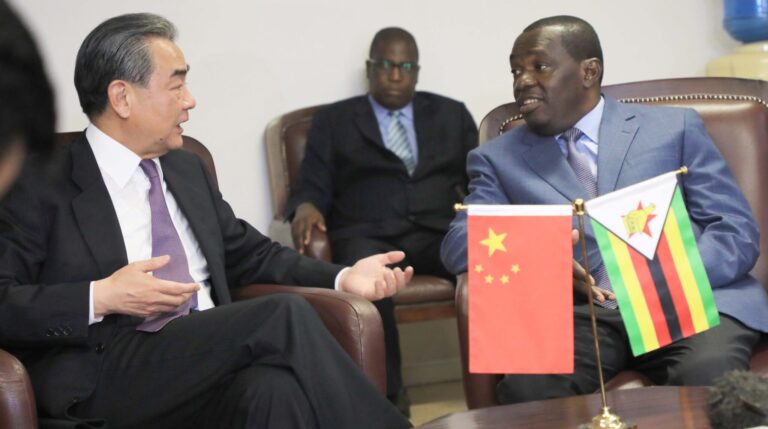
President Xi Jinping’s top diplomat and Foreign Affairs Minister Wang Yi has arrived in the country on an assignment by the Asian country’s leader, seen as a special show of strong commitment by Beijing to grow relations with Harare in 2020.

Mr Wang arrived at the Robert Mugabe International Airport last night in what was his final stop-over on a five-nation mission that has seen him hold high-level meetings in Egypt, Djibouti, Eritrea and Burundi.

Foreign Affairs and International Trade Minister Sibusiso Moyo welcomes the Chinese Foreign Affairs minister Wang Yi at Robert Gabriel Mugabe Interbnational Airport in Harare yesterday.-Picture: Tawanda Mudimu
In the past 30 years, China has made it a tradition for its foreign minister to visit African countries as the first overseas destination of the year, to show how Beijing values its relations with the continent.

That President Xi chose Zimbabwe as one of the five African countries for the annual visit underscores how he places a premium to his engagements with President Emmerson Mnangagwa.

Zimbabwe and China in 2018 elevated relations to Comprehensive Strategic Partnerships from All-Weather Friends and Minister Wang’s visit is expected to see practical implementation of this enhancement of ties on the diplomatic as well as economic front.

China is the biggest investor of infrastructure projects currently underway in Zimbabwe and it is expected that the visit will also give fresh stimulus to mega projects such as the US$1,1 billion Hwange 7 and 8 power expansion project, the US$100 million New Parliament building in Mt Hampden and the US$153 million Robert Mugabe International Airport facelift, among other projects.

Speaking ahead of the visit last week, Foreign Affairs and International Trade Minister Dr Sibusiso Moyo said Zimbabwe was honoured by Minister Wang’s high-level deputation.

“Yes, indeed the People’s Republic of China Foreign Affairs Minister and State Counsellor is visiting Zimbabwe from the 11th to the 13th,” he said,

“Zimbabwe is the last lap of his five-nation journey in Africa. This is in tradition with Chinese visits at the beginning of each year.

“This is a very important visit because it is from a very friendly nation to Zimbabwe. It is a nation that has contributed very much to the development of Zimbabwe and where it is today.”

Dr Moyo said the visit by Minister Wang underlines how President Xi is keen to follow up on engagement that he had with President Mnangagwa when the two Heads of State met twice in China in 2018.

“We believe that we are honoured to have the State Counsellor coming to Zimbabwe as a follow-up to issues that were discussed between President Mnangagwa and President Xi twice, during his State visit to China and during FOCAC.”

The visit, Dr Moyo said, will see the two countries conducting comprehensive deliberations under the Comprehensive Strategic Partnerships theme.

Foreign Affairs and International Trade Minister Sibusiso Moyo welcomes the Chinese Foreign Affairs minister Wang Yi at Robert Gabriel Mugabe Interbnational Airport in Harare yesterday.-Picture: Tawanda Mudimu
Minister Wang’s visit will also present Zimbabwe with an opportunity to formulate strategies to expand trade with China, which is the world’s second largest economy.

“We believe that we are going to have in-depth discussions on our Strategic Comprehensive Partnership and also ensure that we cement the political relations that exist between the two countries.

“Furthermore, we will explore more ways of how China can enhance and support economic development of Zimbabwe.

“In this regard, we are also going to have a discourse in the trade area framework so that we can improve the trade figures between China and Zimbabwe.

“Already, trade has reached the US$1 billion mark and we hope that within the context of the 7 to 14 export strategy, we should be able to enhance our exports to China in a very competitive manner

“We are going to be appreciating that industry, mining, agriculture, tourism and all the other key sectors will come up to speed so that we can be able to utilise the huge market being offered by China.”

In a statement, China’s Foreign Affairs Ministry spokesperson Mr Geng Shuang said Mr Wang’s visit to Africa was also in line with the 20th anniversary of the inception of the Forum on China Africa Cooperation (FOCAC).

According to Mr Geng, the Chinese Foreign Minister will seek to, “… implement the important consensus reached by President Xi Jinping and African leaders and jointly follow through on the outcomes of the (last) FOCAC Beijing Summit with a view to advancing China-Africa BRI cooperation, building on China-Africa traditional friendship and moving forward the bilateral ties between China and relevant African countries as well as China-Africa relations as a whole.”

At the last FOCAC Summit held in Beijing in 2018, President Xi extended an unconditional US$60 billion in loans and aid to Africa until 2021.

The money includes US$15 billion in grants, interest-free loans and concessional loans, US$20 billion in credit lines and a US$10 billion special fund for development financing.

Chinese companies were also encouraged to invest at least US$10 billion in Africa over the next three years.

Deliberations will also touch on China’s signature foreign policy initiative, the Belt Road Initiative (BRI), in which the Asian Giant plans to invest US$750 billion in countries’ under the old Silk Road route and import US$24 trillion of goods into China.

This year, Zimbabwe and China will also be celebrating 40 years of diplomatic relations and a series of events are going to be held throughout the year in line with the anniversary.

Machete gangsterism: Is govt complicit?

0

Gabriel Banda

BY KENNEDY NYAVAYA

MAZOWE — Taking sips of opaque beer, Gabriel Banda (37) enjoys an intermittent break from digging a new pit a stone’s throw away.

Visibly deep in thought, the gold panner sits on a rock at the summit of a mountain adjacent to the decommissioned Jumbo Mine.

From that vantage point, one can see hordes of young men clothed in reddish-brown dust, torches strapped on their foreheads and some carrying equally dirty bags.

Dusk is fast approaching and Mazowe’s mountainous Jumbo Mine community is a hive of activity as the youthful population hastens to wrap up another scorching day of hard work.

Many are headed home before the sun sets.

“When it gets dark, it becomes scary because gang members usually come on the ground to restock their food and other necessities and if they bump into you milling around, they can capture and rob you,” explains Banda, who came here over four months ago.

Before coming to Mazowe, the father of three from Mvurwi, 62km north west of here, spent years as a chrome miner in the Great Dyke before the mine closed down.

Despite over a decade’s experience in extracting minerals, he said the ruthlessness he has seen exhibited by machete gangs, known to this community as Mabhudhi (big brothers) or the cliché title MaShurugwi, has shaken him to the core.

They commit callous murders even in broad daylight without even pondering about it — perhaps the way one would slaughter a chicken.

“We have decided to dig for the gold belt from this hill near residential areas, where prospects of danger are minimal because working from inside the big mine is more dangerous. The Mabhudhi are harming people with Colombian knives (other name for machetes),” Banda claimed.

These machete gangs’ reign of terror has made artisanal mining in this gold-rich district a very risky enterprise.

“One can spend days working inside Jumbo Mine, but if gangs bump into you, they can take away your ore, torches and other belongings; that is if they decide to leave you alive or do not decide to detain and make you mine more for them,” he said.

It is estimated that there are thousands of unlicensed miners working there every day in a partially descending maze of surface levels that stretch for kilometres underground.

The mere decision to get in is a dice with death and those more cautious about their lives restrict themselves to levels closer to the ground, despite the prospects of reaping greater rewards further down the rickety shafts.

A few days ago, Banda recalls, one unlucky miner nicknamed Dhigo met his fate in cold blood after hitting the jackpot underground.

“They stabbed him, took his stones and, just like that, he was gone,” he said in a distraught tone.

An unclaimed corpse is all that is left to decompose in what has become the norm for those who breathe their last inside the canals of Jumbo Mine.

While falling stones still claim lives, many are said to be victims of increasing gang turf wars. The gangs are usually groups of 15 or more armed men ready to snuff out the life in anyone who dared cross their path.

Shockingly, apart from days of sporadic crackdowns, as is currently the case, law enforcers in the area are said to care less.

“Security is always there, but they do not go underground no matter the circumstances,” says a local miner, who only identified himself as Wonder.

“They only deal with issues on top of the ground and they say they were not trained to go underground.”

Wonder also detailed an account of how a US$10 bribe and a meticulous search is all that is needed for one to gain access into the heavily guarded shaft.

What puzzles him, however, after encountering Mabhudhi two times in the past year, is how the criminals get in with dangerous weapons including machetes, spears and knives.

“With that kind of search, it should not be possible to even enter with a razor blade, so where do those big weapons come from?” he quizzed rhetorically.

“There might be corrupt business going on there and perhaps they pay more money.”

If true, this probably makes the police force complicit to a spate of violence that has gripped the entire country of late.

Mashonaland Central police spokesperson Inspector Milton Mundembe, however, rubbished the corruption allegations, stressing that they were intensifying their crackdown on the gangs in Mazowe.

“We are not aware of that (taking of bribes), but perhaps if we could get tip-offs that such crimes are taking place, then arrests will be made,” he said.

Mundembe admitted that arresting the MaShurugwi was no child’s play.

“We are there to eliminate unruly elements, but arresting these armed gangs is not an easy task, so we are increasing our efforts to end the menace forever,” he said.

In December last year, a police officer was bludgeoned to death while his colleague was injured in an attack by the MaShurugwis who had invaded Good Hope Mine in Kadoma, while others were early this week arrested after storming a Gokwe North police base, sparking a bloody confrontation, as they wanted to rescue their arrested colleagues.

Police Commissioner-General Godwin Matanga had hinted at the possibility of implementing a “shoot-to-kill” policy.

There have also been urgent calls to stiffen the hunt on these criminals by bringing the national army into the fray, but there appears to be reluctance.

Instead, the Mines and Mining Development Parliamentary Committee has set up an inquiry to scrutinise the origins of machete gangs.

“We have discussed this issue and resolved to conduct an inquiry into the matter to identify and trace the foundation and development of the gold panning gang,” the committee chairperson Edward Mukaratigwa was quoted saying.

While reopening of big mines could be a much more sustainable option, it interrogates the current government’s willingness to formalise all mining activities and place a lid on gory gold deals some of them are fingered in.

As more big mines close or scale down in response to a failing economy, artisanal mining now reportedly accounts for over 60% of all the gold delivered to Fidelity Printers and Refineries, the country’s sole legal gold buyer.

Gold panners at Jumbo Mine yearn for protection of their hard-earned livelihoods currently under threat from the marauding machete gangsters.

“All these illegal mining activities you see are a result of high unemployment and if a mine like Jumbo is reopened, it could usher in a much more orderly and safer way of doing things here,” Banda
suggested.

Machete gangsterism: Is govt implicit?

0

Gabriel Banda

BY KENNEDY NYAVAYA

MAZOWE — Taking sips of opaque beer, Gabriel Banda (37) enjoys an intermittent break from digging a new pit a stone’s throw away.

Visibly deep in thought, the gold panner sits on a rock at the summit of a mountain adjacent to the decommissioned Jumbo Mine.

From that vantage point, one can see hordes of young men clothed in reddish-brown dust, torches strapped on their foreheads and some carrying equally dirty bags.

Dusk is fast approaching and Mazowe’s mountainous Jumbo Mine community is a hive of activity as the youthful population hastens to wrap up another scorching day of hard work.

Many are headed home before the sun sets.

“When it gets dark, it becomes scary because gang members usually come on the ground to restock their food and other necessities and if they bump into you milling around, they can capture and rob you,” explains Banda, who came here over four months ago.

Before coming to Mazowe, the father of three from Mvurwi, 62km north west of here, spent years as a chrome miner in the Great Dyke before the mine closed down.

Despite over a decade’s experience in extracting minerals, he said the ruthlessness he has seen exhibited by machete gangs, known to this community as Mabhudhi (big brothers) or the cliché title MaShurugwi, has shaken him to the core.

They commit callous murders even in broad daylight without even pondering about it — perhaps the way one would slaughter a chicken.

“We have decided to dig for the gold belt from this hill near residential areas, where prospects of danger are minimal because working from inside the big mine is more dangerous. The Mabhudhi are harming people with Colombian knives (other name for machetes),” Banda claimed.

These machete gangs’ reign of terror has made artisanal mining in this gold-rich district a very risky enterprise.

“One can spend days working inside Jumbo Mine, but if gangs bump into you, they can take away your ore, torches and other belongings; that is if they decide to leave you alive or do not decide to detain and make you mine more for them,” he said.

It is estimated that there are thousands of unlicensed miners working there every day in a partially descending maze of surface levels that stretch for kilometres underground.

The mere decision to get in is a dice with death and those more cautious about their lives restrict themselves to levels closer to the ground, despite the prospects of reaping greater rewards further down the rickety shafts.

A few days ago, Banda recalls, one unlucky miner nicknamed Dhigo met his fate in cold blood after hitting the jackpot underground.

“They stabbed him, took his stones and, just like that, he was gone,” he said in a distraught tone.

An unclaimed corpse is all that is left to decompose in what has become the norm for those who breathe their last inside the canals of Jumbo Mine.

While falling stones still claim lives, many are said to be victims of increasing gang turf wars. The gangs are usually groups of 15 or more armed men ready to snuff out the life in anyone who dared cross their path.

Shockingly, apart from days of sporadic crackdowns, as is currently the case, law enforcers in the area are said to care less.

“Security is always there, but they do not go underground no matter the circumstances,” says a local miner, who only identified himself as Wonder.

“They only deal with issues on top of the ground and they say they were not trained to go underground.”

Wonder also detailed an account of how a US$10 bribe and a meticulous search is all that is needed for one to gain access into the heavily guarded shaft.

What puzzles him, however, after encountering Mabhudhi two times in the past year, is how the criminals get in with dangerous weapons including machetes, spears and knives.

“With that kind of search, it should not be possible to even enter with a razor blade, so where do those big weapons come from?” he quizzed rhetorically.

“There might be corrupt business going on there and perhaps they pay more money.”

If true, this probably makes the police force complicit to a spate of violence that has gripped the entire country of late.

Mashonaland Central police spokesperson Inspector Milton Mundembe, however, rubbished the corruption allegations, stressing that they were intensifying their crackdown on the gangs in Mazowe.

“We are not aware of that (taking of bribes), but perhaps if we could get tip-offs that such crimes are taking place, then arrests will be made,” he said.

Mundembe admitted that arresting the MaShurugwi was no child’s play.

“We are there to eliminate unruly elements, but arresting these armed gangs is not an easy task, so we are increasing our efforts to end the menace forever,” he said.

In December last year, a police officer was bludgeoned to death while his colleague was injured in an attack by the MaShurugwis who had invaded Good Hope Mine in Kadoma, while others were early this week arrested after storming a Gokwe North police base, sparking a bloody confrontation, as they wanted to rescue their arrested colleagues.

Police Commissioner-General Godwin Matanga had hinted at the possibility of implementing a “shoot-to-kill” policy.

There have also been urgent calls to stiffen the hunt on these criminals by bringing the national army into the fray, but there appears to be reluctance.

Instead, the Mines and Mining Development Parliamentary Committee has set up an inquiry to scrutinise the origins of machete gangs.

“We have discussed this issue and resolved to conduct an inquiry into the matter to identify and trace the foundation and development of the gold panning gang,” the committee chairperson Edward Mukaratigwa was quoted saying.

While reopening of big mines could be a much more sustainable option, it interrogates the current government’s willingness to formalise all mining activities and place a lid on gory gold deals some of them are fingered in.

As more big mines close or scale down in response to a failing economy, artisanal mining now reportedly accounts for over 60% of all the gold delivered to Fidelity Printers and Refineries, the country’s sole legal gold buyer.

Gold panners at Jumbo Mine yearn for protection of their hard-earned livelihoods currently under threat from the marauding machete gangsters.

“All these illegal mining activities you see are a result of high unemployment and if a mine like Jumbo is reopened, it could usher in a much more orderly and safer way of doing things here,” Banda
suggested.

Zim’s new Parly symbolises China’s chequebook diplomacy approach

0

With China’s help, a new city is taking shape on the outskirts of Zimbabwe’s capital Harare, as Beijing deepens its influence in Africa.

A US$140 million six-storey parliament building being constructed on Mount Hampden, about 18km northwest of Harare, is the linchpin of a move by the southern African country to ease congestion in the crowded capital.

Sitting on the top of a hill, the imposing circular complex being erected by China’s Shanghai Construction Group is fully paid by Beijing, which regards the gesture as a donation.

The 33 000 square metres complex will replace the current 100-seat, colonial-era building which Zimbabwean officials consider too small for the country’s 350 legislators.

Besides the Parliament, the Zimbabwean government also plans to relocate some of its administrative units, including its judiciary and executive branches, to the site, where a state house and official residences for the speaker of the House of Assembly and president of the Senate also will be built.

The new city will also become home to the country’s reserve bank, upmarket suburbs, hotels and shopping malls.

President Emmerson Mnangagwa has made three visits to the site since its groundbreaking last year. During his latest visit on November 27, Mnangagwa expressed appreciation to China for the donation.

Zhao Baogang, the Chinese deputy ambassador to Zimbabwe, said the project was “a symbol of the friendship between China and Zimbabwe”.

“The building is important in the decolonisation of Zimbabwe,” he said. It is expected to be completed by March 2021.

Paying for the construction of grandiose symbols of the state, such as presidential palaces and parliamentary buildings, through grants or interest-free loans, has been one of Beijing’s major diplomatic strategies on the continent.

When China first started establishing diplomatic relations with Africa between the 1950s and 1970s, it used offers of financial help and interest-free loans and sent over medical teams to endear itself to African countries.

In return, those nations helped Beijing secure a seat on the United Nations Security Council in 1971. Until then the seat had been occupied by the Republic of China government seated in Taiwan.

But it was the construction of the Tanzania-Zambia Railway (Tazara), Beijing’s most ambitious and expensive project, that did the most to boost China’s political capital on the continent.

The railway, which was built between 1970 and 1975 for US$500 million via an interest-free loan to be repaid over 30 years, necessitated the deployment of 25 000 Chinese workers. Once completed, the line stretched almost 1 870km from Dar es Salaam Port to the Zambian town of Kapiri Mposhi, where the country’s coal mines are situated.

Beijing has since funded several projects, including soccer stadiums, in nations such as Cameroon, Mozambique, Malawi, Ghana, Angola and Zambia. It has also paid for parliamentary buildings in the Republic of Congo, Lesotho, Mozambique and Sierra Leone. Further, China has gifted presidential palaces to countries such as Togo, Sudan, Burundi and Guinea-Bissau.

The trend has picked up recently with Beijing bankrolling the building of the US$200 million African Union headquarters in the Ethiopian capital, Addis Ababa.

Also, last year, Beijing said it would fund the building of the new headquarters for the Economic Community of West African States in Abuja, Nigeria, for US$31,6 million.

Meanwhile, China is building a US$58 million parliamentary complex in the Republic of Congo (Brazzaville) and rebuilding the burnt parliament in Gabon.

Two weeks ago, Zambia announced that China has agreed to fund construction of a new international conference centre that will be used to host the African Union Heads of State Summit in 2022.

During the 2018 Summit of the Forum on China-Africa Co-operation in Beijing, Chinese President Xi Jinping pledged to extend US$60 billion in financing to Africa over three years.

That will include US$15 billion in grants, interest-free loans and concessional loans, US$20 billion in credit lines, the setting up of a US$10 billion special fund for development financing and a US$5 billion special fund for financing imports from Africa.

China is the continent’s largest bilateral lender, pouring billions of dollars into African countries for the building of motorways, dams and railways under the Belt and Road Initiative, the multibillion-dollar plan to link Asian and European economies to a China-centred trading network.

China advanced more than US$143 billion between 2000 and 2017, according to figures from the China Africa Research Initiative at the Johns Hopkins School of Advanced International Studies in Washington. Chinese aid to Africa stood at US$29,4 billion between 2003 and 2017, the figures showed.

Obert Hodzi, an international relations scholar at the University of Liverpool, said these infrastructure “gifts” were meant to show China’s benevolence, its willingness to share its prosperity with other developing countries and its sacrificial giving that has endeared it to African leaders since the Tazara railway.

These gifts, he said, also allowed Beijing to re-emphasise the tangible and much-needed infrastructure benefits it provided to African economies — differentiating it from Western powers that focus on “intangible issues of governance and human rights” widely seen as disruptive by the ruling elites in Uganda, Zimbabwe and Zambia.
“Currently, the strategy is working,” Hodzi said. “(President Yoweri) Museveni has recently praised the Chinese for not being jealous of Uganda and caring about its development. Beijing also hopes that recipient governments will reciprocate by favouring Chinese businesses.”

David Shinn, an American diplomat and adjunct professor at George Washington University’s Elliott School of International Affairs, said China’s practice of building, at no charge, the African Union headquarters, regional African organisation headquarters, presidential palaces, military headquarters, public stadiums and political party headquarters was “brilliant public relations and probably buys a great deal of influence with African governments, regional organisations and the general public”.

But he questioned whether African leaders really believed the projects involved no quid pro quo, as Chinese diplomats often claim. If so, they were mistaken, he said.

“African leaders can be excused for taking no interest in Chinese internal issues such as human rights, the treatment of Uygurs in Xinjiang, the situation in Tibet, the building of islands in the South China Sea and the status of Hong Kong,” Shinn said.

“But a surprising number of African governments are supporting China’s position on these policies. That is where the quid pro quo comes into play.”

Stephen Chan, a professor of world politics at the University of London’s School of Oriental and African Studies, said China built prestige projects internationally.

“They sit alongside the infrastructure projects — roads, railways — for which China is well known,” he said.

“But they are not as expensive. In a way, it is visibility for less outlay. It also gives exposure to Chinese construction firms. For China, it is a win-win situation.”

But critics have questioned the motives behind China’s largesse. Last year, a French newspaper Le Monde claimed Beijing was spying on the African Union (AU), saying it had installed hidden microphones in the building and was taping sensitive information.

Beijing dismissed the report’s “groundless accusations”, while the AU called them “baseless”.

Analysts say China’s efforts to gift imposing projects is part of its broader chequebook diplomacy programme in Africa to win the affection and allegiance of its elite.

Bradley Parks, executive director of AidData, a research lab at the College of William and Mary in the US state of Virginia, said Beijing often plied African leaders with lavish spending on projects, such as stadiums, theatres, museums and parliamentary buildings, that disproportionately benefited urban elites.

Beijing’s purpose was partly to secure African countries’ support for its policy positions such as its opposition to the South China Sea arbitration process at the Permanent Court of Arbitration in The Hague and its adherence to a “one-China” policy on Taiwan, he said.

Parks was part of a team that recently published an AidData paper showing that Chinese aid was used either to buy African governments’ support for its foreign policy or as a reward for them providing it.

“Across the continent, we find that there is a strong, positive, and statistically significant relationship between Chinese aid provision and voting with China in the UN General Assembly (UNGA),” he said.

“To give you a sense of the magnitude of this effect, our statistical model indicates that a 10% increase in UNGA voting similarity with China yields an 86% increase in Chinese aid, on average,” he said.

As an example, he said, the model predicted that if Rwanda moved from its 67% level of voting alignment with China in the UN General Assembly to Egypt’s level — 93%, the maximum level of UN voting alignment with China in their Africa sample — it would see a 289% increase in aid from China.

Conversely, if Egypt’s 93% level of voting alignment with China in the UN General Assembly fell to Equatorial Guinea’s level (65%), “our statistical model predicts that Egypt would see an 87% reduction in aid from China”, Parks said.

— South China Morning Post

Schools get blank cheque on fees

0

BY BLESSED MHLANGA

SCHOOLS have received a blank cheque to increase school fees according to market forces despite government’s earlier moves to block “unjustified fees hikes”.

Acting Primary and Secondary Education minister Amon Murwira yesterday confirmed the development, saying only tuition would remain unchanged.

He said levies could be increased in line with market forces, only after at least 20% of the parents vote to approve the increase.

“The issue that I talked about is no tuition fee increases. Boarding fees, food
fees are subject to market forces. Therefore, that one will be charged reasonably,” Murwira said.
“They have been given guidelines on how to proceed with boarding fees. What we are talking about here are tuition fees and that there will be no tuition fee increases in our public schools.”
This came a week after President Emmerson Mnangagwa warned school authorities against hiking fees without government approval.
Schools collect levies, which are controlled by School Development Committees (SDC), and most government schools charge $10 per term as tuition, which is managed by headmasters.

Murwira said government had allocated $8 billion to the ministry, which would be used to finance procurement of stationery, owing to a shortfall that will be created after blocking tuition increases.

“We must also know that the Ministry of Primary and Secondary Education has a budget of $8 billion. The tuition fees are going to move towards helping this, but they are not a complete solution to it,” he said.

“Government is investing a lot to move towards free basic education as per the Constitution, so that’s why the ministry is given such a budget. It is important to note that public schools are not only funded from tuition, they are funded (by) the taxpayer.”

Government has been failing to fund schools over the past years and even owes a number of institutions a lot of money in unpaid Basic Education Assistance Module (BEAM) fees.

Treasury has also been accused of failing to pay fees for war veterans’ children.
Murwira said this mistake would be corrected starting this year.

“We have allocations from Treasury for that. If there have been no speedy releases in the past, we are talking about the future here,” he said.
On private schools charging fees in foreign currency directly or indirectly, Murwira said: “Government has also learnt that some private schools are charging directly or indirectly in forex. Responsible authorities of such schools are warned that they risk deregistration of such schools,” he said.

Government teachers have threatened to down tools and not show up next Tuesday when schools open over a salary wrangle with their employer, but Murwira ducked the question saying he was spurred by hope.
“We are obviously concerned, but the reason I wake up every day and work is because I have hope. At this point, we are not talking about that because it’s in the hands of the Public Service Commission. We are talking about school fees at the moment,” he said.

Jairos Jiri must be turning in grave

0

ACCORDING to a very brief, but incisive synopsis on the web-based free content encyclopaedia, Wikipedia, in 1950 a Zimbabwean philanthropist by the name Jairos Jiri set up an organisation in his name in the City of Bulawayo. The association he formed was meant to support and train disadvantaged people mainly people living with disabilities (PWDs).

NewsDay Comment

“Jairos Jiri, using Christian principles, wanted to help individuals who previously had been marginalised and rejected. Initially the association supported arts endeavours and training and set up craft outlets selling tourist souvenirs, such as carvings, paintings, tiles and furniture. In the 1970s legal representation and affiliate support groups were founded in the United Kindgom. Jairos Jiri Association now houses the disadvantaged, support music and dance groups, and is a powerful advocacy for those who would otherwise have no voice in Zimbabwe,” writes Wikipedia.

However, 70 years down the line, Jiri’s legacy largely lies in tatters with every institution set up in his name facing collapse due to neglect and obviously poor management and lack of appreciation of what the visionary philanthropist bequeathed nation Zimbabwe. When Jiri died in 1982 he left behind 16 centres across the country catering for the disadvantaged, especially PWDs. But today the man Jairos Jiri must be turning in his grave as those institutions, which were all developing into self-sustaining organisations through income-generating projects, are turning into empty shells with the latest being Jairos Jiri Masvingo which closed down a few weeks back due to lack of water.

While the prevailing harsh economic situation in the country has obviously not spared the institutions Jiri bestowed to the country, it is, however, sad that centres which had stood the test of time are being run down to the point that they can no longer sustain themselves. All Jairos Jiri Masvingo centre needed was adequate and constant supply of water to sustain its agricultural programme. And given the food situation in the country with enough supply of water it is difficult to even imagine how the centre could not have managed to flourish through growing and selling farm produce or even rearing livestock.

It is quite disturbing that when asked about the centre’s predicament, Jairos Jiri Association national director Wilson Ruvere initially said all was well at the centre before admitting that the institution had shut down. Trying to hide the truth tells a lot about what could be happening at Jairos Jiri because if the association is still operating along Christian principles then all those working there, especially the directors, must be honest people who are never evasive. In fact, Ruvere should have been the first one to contact the Press or beam an appeal via the media after problems visited Jairos Jiri Masvingo. But alas he and his colleagues just shut their mouths and even tried to lie that everything was fine when it was not.

What has happened to Jairos Jiri Masvingo could just be a tip of the iceberg to what is taking place at one of Zimbabwe’s biggest privately-owned institutions that has for 70 years done sterling work, looking after PWDs. There could be more happening to Jairos Jiri’s legacy which is escaping public scrutiny and it would be quite sad if one day we wake up to hear that the association is no more. And predictably, those who will be in charge when the institution collapses will blame donor fatigue. But some of us will always remember that most of the institutions Jiri left behind were almost self-sustaining. Many of us will also remember that those running Jairos Jiri after the death of its founder have been acting dubiously and at one time in 2010 sought to evict Jiri’s window, Betty, from a house in Bulawayo’s Nguboyeja. It took the late former President Robert Mugabe’s intervention to stop the eviction. We also know that Jiri’s son fought those who were left running the association. So it would be prudent for those running Jairos Jiri Association to pose a little and go back to basic founding principles of the association if it is to last a little longer.