

By Samuel Musarika
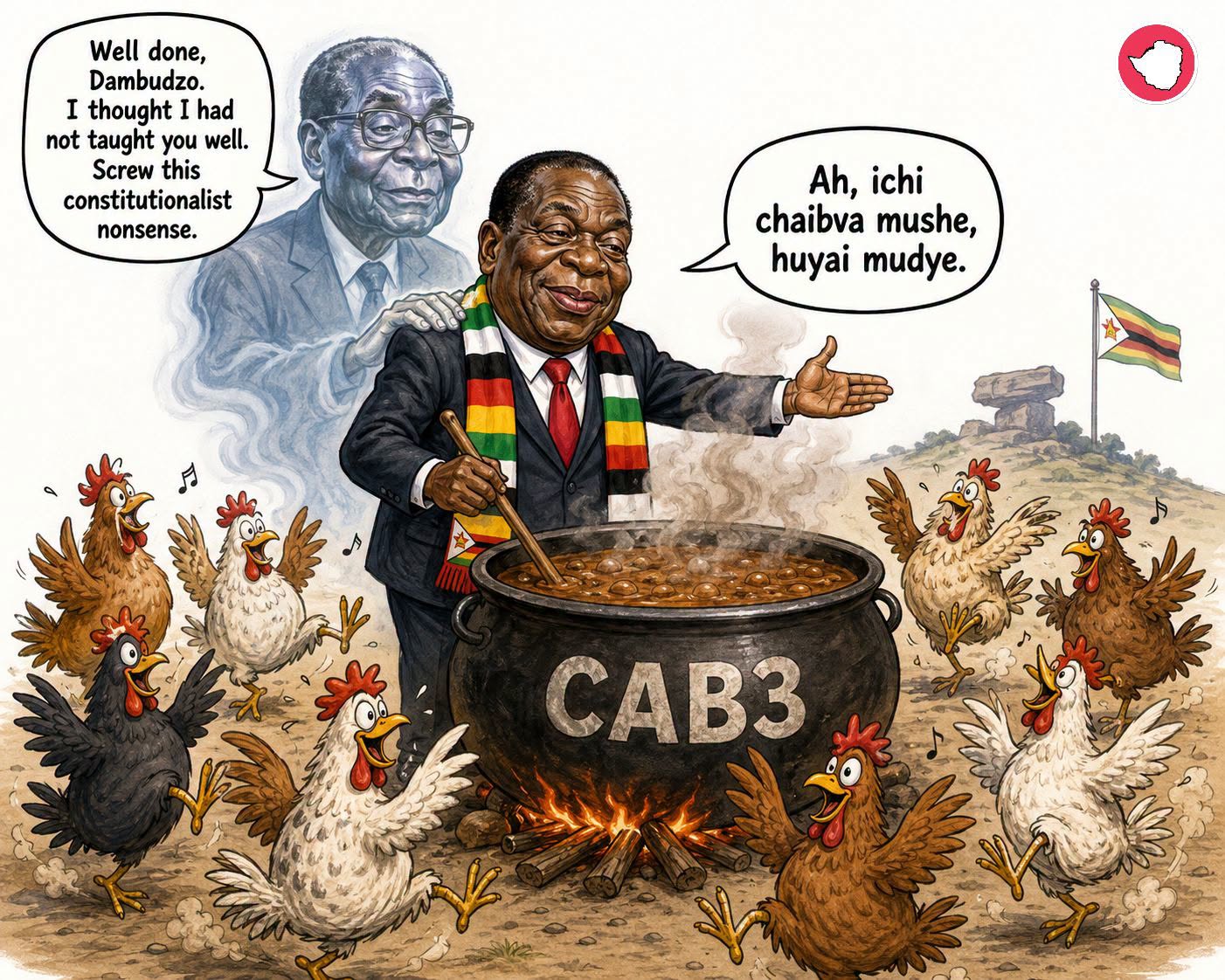
President Emmerson Mnangagwa has signed CAB3 into law. We expected this to happen. ZANU-PF wanted it, ZANU-PF pushed it, ZANU-PF dressed it in constitutional language, and ZANU-PF has now delivered what it always intended to deliver. The gymnastics around words such as “constitutionalism”, “amendment”, “reform” and “legal process” were never convincing. This was always about power. It was always about extending control. It was always about bending the Constitution until it served the ambitions of those who already hold the state.
Let us not mince words. Zimbabwe is behaving like a banana republic. A serious constitutional democracy does not play games with the supreme law of the land in order to accommodate the political appetite of one party and one leader. A serious republic does not treat the Constitution as an inconvenience to be reworded whenever power feels threatened. A serious country does not pretend that a manipulated parliamentary process can replace the people’s direct authority over their own future.
CAB3 is not reform. CAB3 is not development. CAB3 is not constitutional maturity. It is a power grab dressed in legal clothing. It is dictatorship trying to pass through the front door with a government stamp in its hand. ZANU-PF can call it whatever it wants, but Zimbabweans know what this is. It is the weakening of the people’s voice. It is the reduction of public power. It is the conversion of national sovereignty into a parliamentary transaction controlled by those with money, influence and party machinery.
But before Zimbabweans start crying that ZANU-PF has stolen everything, let us also be honest with ourselves. CAB3 is not only a ZANU-PF theft. It is also a gift from public apathy. It is a gift from citizens who sat on their hands while the Constitution was being dragged towards the grave. It is a gift from people who were too tired, too distracted, too cynical or too comfortable to care. It is a gift from a society that often waits until the coffin is lowered before asking why nobody stopped the funeral.
From day one, some of us pushed against CAB3. We warned, wrote, posted, argued, created cartoons, made videos and tried to explain what was at stake. Yet many people were more interested in the messenger than the message. They had time to comment on my beard, my bald head, my glasses, my skin tone and my appearance, but no time to engage the substance of the constitutional vandalism taking place in front of them. That is Zimbabwe’s tragedy. The house was burning, and some people were busy discussing the hairstyle of the person shouting “fire”.
Social media tells its own story. Comedians, entertainers and empty noise can gather crowds. Political content struggles because many Zimbabweans do not want to spend their data on uncomfortable truth. They want laughter, gossip, dancing and distraction. That is their right, of course. But nations are not saved by people who only wake up for entertainment. Constitutions are not defended by people who think political education is “wasting data”. If a people do not value serious political conversation, they should not be shocked when serious political consequences arrive.
CAB3 has now arrived.
Many people placed their faith in General Chiwenga. They waited for a sign, a statement, a coded warning, a dramatic intervention. But Zimbabwe does not need parables. Zimbabwe needs courage, clarity and organisation. Chiwenga has spoken in riddles, just as Nelson Chamisa often speaks in spiritual ambiguity. These are not the horses that will carry Zimbabwe across the river. A nation cannot outsource its constitutional survival to cryptic speeches and whispered expectations. If the people themselves do not rise intellectually, politically and socially, nobody is coming to save them.
That is the painful truth. Zimbabweans keep looking for rescuers. A general. A pastor. A prophet. A foreign government. A court. A faction. A miracle. But democracy does not survive through miracles. It survives through citizens who understand what is being taken from them and refuse to surrender quietly. CAB3 passed because ZANU-PF had the will to push it and the public did not have the will to stop it.
This is why I say Zimbabweans must stop pretending they are merely victims of ZANU-PF. Yes, ZANU-PF is responsible for this constitutional destruction. Yes, ZANU-PF has abused its parliamentary majority. Yes, ZANU-PF has shown once again that it does not respect limits on power. But the people also have a responsibility. Silence has consequences. Apathy has consequences. Political ignorance has consequences. Blind loyalty has consequences. When citizens treat politics as someone else’s problem, power fills the empty space.
Some of the loudest ZANU-PF supporters are sitting in South Africa, the United Kingdom, Canada, Australia and elsewhere, enjoying systems built by other people’s political struggles while defending the very system that forced many Zimbabweans out of their own country. They enjoy South African roads, British hospitals, Western wages and functioning institutions, then turn around and tell Zimbabweans to clap for broken systems at home. They only remember Zimbabwe’s problems when someone in a foreign land tells them to go back. That level of hypocrisy is exhausting.
Now Zimbabwe must live with the consequences.
CAB3 will not bring investor confidence. It will not convince the world that Zimbabwe is stable. It will not attract serious capital. Investors do not only look at roads and interchanges. They look at institutions. They look at rule of law. They look at predictability. They look at whether constitutions mean anything. When a country changes its supreme law to extend political control, the message to the world is simple: power matters more than rules. That is not “open for business”. That is open for dictatorship.
The economic consequences will come. Zimbabwe is already borrowing heavily. Projects are being celebrated, but much of the shine is built on debt, not genuine national capacity. If the debt tap slows or closes, the slogans will not build roads, hospitals or schools. The country may face more pressure, more defaults, more power cuts, more water shortages and more forced reliance on a currency people do not fully trust. I have said before that once CAB3 passes, Zimbabweans should prepare for greater pressure to normalise ZiG. A state that wants control over politics will also want control over money.
This is not doomsaying. This is analysis. A country cannot undermine its Constitution, scare away confidence, borrow endlessly, celebrate cosmetic development and expect to arrive in a promised land of milk and honey. You cannot build Vision 2030 on constitutional vandalism, debt, propaganda and fear. At some point, the numbers must speak. At some point, the roads need maintenance, the hospitals need medicine, the grid needs power, the schools need teachers and the people need incomes. Slogans will not pay those bills.
So yes, CAB3 is now law. It is a sad day. But it is also a revealing day. It has revealed ZANU-PF for what it is. It has revealed Mnangagwa’s constitutionalist language as empty. It has revealed the weakness of the opposition. It has revealed the limits of waiting for generals. It has revealed the danger of citizens who only care when it is too late.
History will remember this moment. It will remember who pushed CAB3. It will remember who defended it. It will remember who stayed silent. It will remember who mocked the messengers. It will remember who spent more time discussing beards than constitutional destruction. It will remember who clapped while the Constitution was being cooked in a pot of political ambition.
CAB3 may be law now, but that does not make it right. It does not make it moral. It does not make it democratic. It simply proves that in Zimbabwe, power can still bully principle and call it procedure.
With great sadness, we must now say it plainly: CAB3 is done. Zimbabwe has entered another painful chapter. Whether the people wake up from here is the only question that remains.
