

Our recent article examining whether extending President Emmerson Mnangagwa’s term might be the “least bad option” has been widely circulated. Unfortunately, some political actors have attempted to misrepresent that argument as an endorsement of Constitutional Amendment Bill No. 3.
It was not.
The point of the article was analytical, not political. It explored a hypothetical scenario in which continuity of leadership might be preferable to instability in a political environment where succession battles within the ruling party could destabilise the country.
However, there is one critical condition that cannot be ignored.
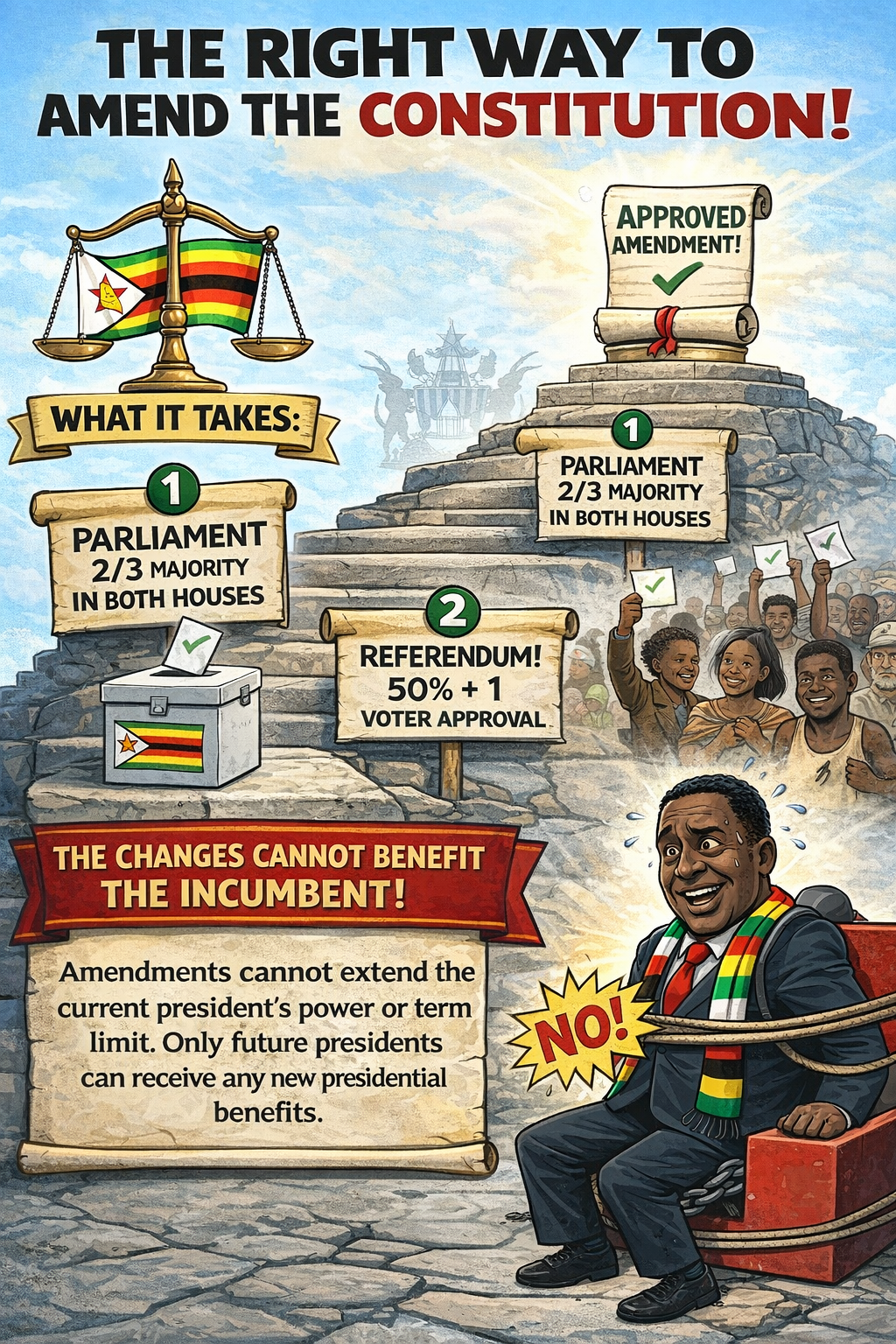
Any change to presidential tenure must strictly follow the Constitution of Zimbabwe.
If that condition is not met, then the proposal immediately moves from being a theoretical “least bad option” to becoming a very dangerous precedent.
The Constitution Is Not Optional
Zimbabwe’s Constitution is very clear on how it can be amended. Certain provisions, particularly those that affect presidential tenure and executive power, cannot simply be altered through ordinary parliamentary procedures.
They require the direct involvement of the people through a referendum.
This is not a technicality. It is a fundamental safeguard designed to prevent those in power from reshaping the Constitution to serve their own political interests.
Claims that such amendments can be pushed through Parliament alone contradict both the spirit and the structure of the Constitution.
A change of this magnitude must be approved by the people of Zimbabwe themselves.
The Incumbent Cannot Benefit
There is an even more important constitutional limitation that many proponents of the amendment appear to ignore.
Section 328(7) of the Constitution states that any amendment which extends the length of a presidential term does not apply to the person who is currently holding that office.
In simple terms, even if the Constitution were amended, the sitting President cannot benefit from those changes.
This safeguard was deliberately written into the Constitution to prevent exactly the kind of situation Zimbabwe now faces.
The rule ensures that constitutional changes are made for the future of the country, not for the immediate benefit of the individual currently in power.
The Danger of Ignoring the Constitution
If Zimbabwe begins to treat the Constitution as something that can be bent or reinterpreted for political convenience, the consequences will be severe.
The Constitution is the foundation of our legal and democratic order. Once that foundation is weakened, every other institution in the country becomes vulnerable.
Ignoring constitutional safeguards in order to extend the tenure of a sitting president would damage Zimbabwe’s credibility, weaken investor confidence, and further erode trust in public institutions.
Even those who support the current administration should recognise the long-term risks of creating such a precedent.
The Rule of Law Must Come First
The original argument that leadership continuity might be the “least bad option” only holds if the Constitution is respected.
Without that respect, the proposal becomes the opposite: one of the worst options available.
Zimbabwe cannot build a stable and prosperous future if its leaders treat the Constitution as an obstacle rather than the supreme law of the land.
President Mnangagwa’s current term ends in 2028. That is what the Constitution provides.
And unless the people of Zimbabwe approve a change through a proper constitutional process, that is where the matter must end.
