

Zimbabwe is routinely described as an “agro-based economy”. It is a phrase repeated by politicians, commentators and even parts of the media as though it remains an unquestionable description of the country. Agriculture is unquestionably important to Zimbabwe, but the latest economic data tells a different story. If “agro-based” is supposed to mean that agriculture is the dominant contributor to the economy or the country’s main source of foreign currency, then Zimbabwe can no longer accurately be described that way.
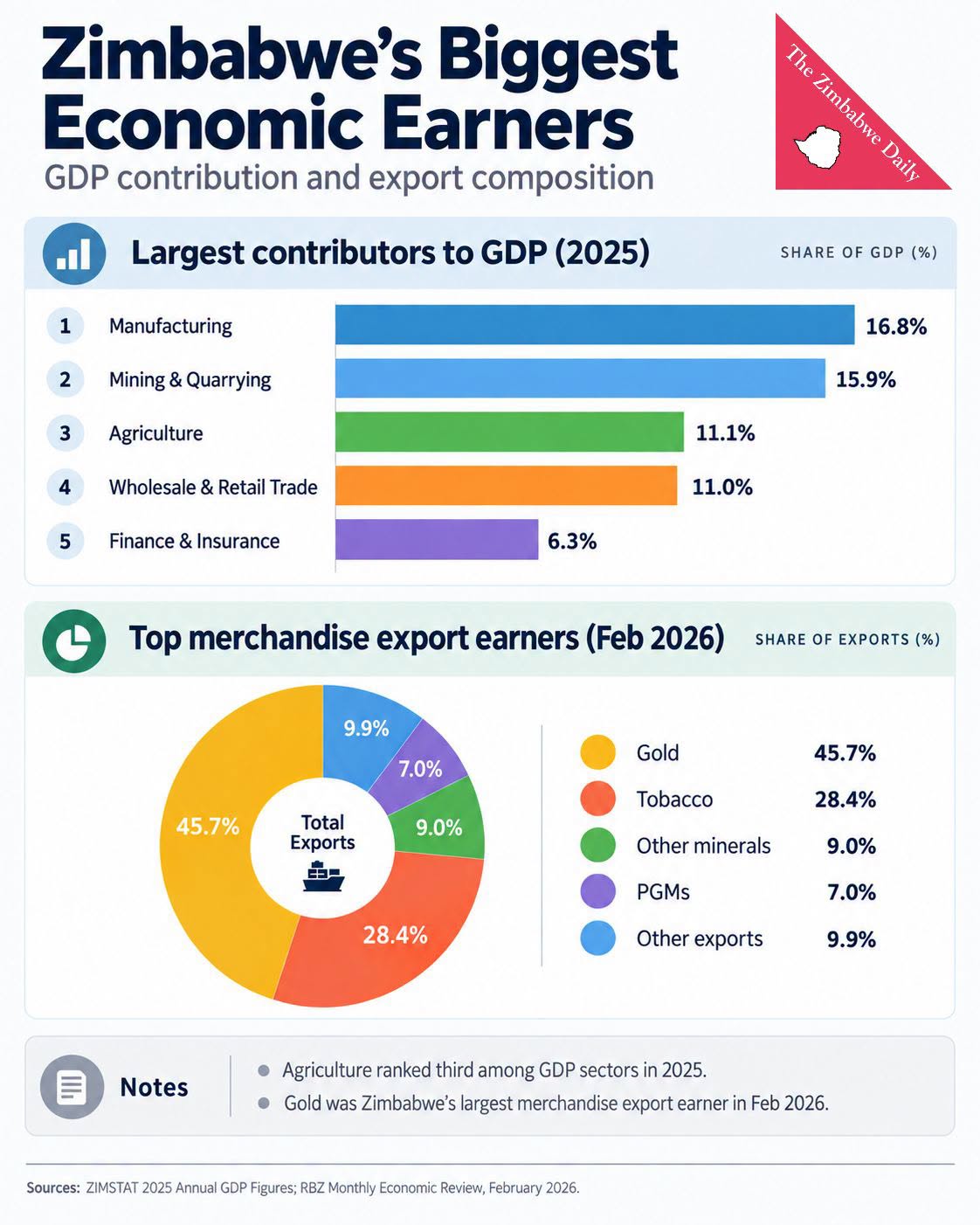
According to ZIMSTAT’s 2025 GDP figures, manufacturing was the largest individual contributor to GDP at 16.8%, followed by mining and quarrying at 15.9%. Agriculture accounted for 11.1%, almost level with wholesale and retail trade at 11.0%. Finance and insurance contributed 6.3%. Agriculture therefore remains a major part of the economy, but it ranked only third among the largest individual sectors.
The picture becomes even clearer when we look at what Zimbabwe actually sells to the rest of the world. In February 2026, gold alone accounted for 45.7% of merchandise exports. Tobacco, Zimbabwe’s biggest agricultural export, accounted for 28.4%, while other minerals contributed 9.0% and platinum group metals another 7.0%. That means gold by itself earned considerably more from exports than tobacco, while the wider mining sector was overwhelmingly important to Zimbabwe’s export basket.
This is why there is an important distinction between saying that Zimbabwe has a large agricultural sector and saying Zimbabwe is an agro-based economy. Agriculture remains critical. It feeds the population, supports millions of livelihoods, supplies industries and remains especially important in rural Zimbabwe. A good agricultural season can also have a significant effect on overall economic growth. Indeed, agriculture recorded very strong growth of 27.9% in 2025. But importance is not the same thing as dominance.
There is another major source of foreign currency that is sometimes overlooked: Zimbabweans living abroad. Diaspora remittances have become a substantial part of the country’s foreign currency inflows. In the first half of 2025, Zimbabwe received about US$1.09 billion in diaspora remittances, equivalent to 15.1% of total foreign currency receipts during that period. More recent Reserve Bank figures show diaspora remittances accounting for about 14.8% of foreign currency receipts in the first quarter of 2026, second only to export earnings among the major recurring sources of foreign exchange.
It is worth noting that diaspora remittances should not technically be placed under the “finance and insurance” sector in GDP statistics. They are transfers of money into Zimbabwe from people living abroad and are recorded separately as external financial inflows. But economically, their importance is enormous: Zimbabwe now relies heavily not only on what it grows and mines at home, but also on money earned by Zimbabweans outside the country.
So perhaps it is time to retire the automatic description of Zimbabwe as an agro-based economy. Zimbabwe still has a major agricultural economy, but its modern economic structure is much broader. Manufacturing leads GDP contribution, mining is close behind and minerals dominate export earnings, while diaspora remittances have become one of the country’s most important sources of foreign currency.
Agriculture remains one of Zimbabwe’s pillars. It is simply no longer the pillar around which the entire economy can accurately be described.
