


The Bulawayo to Victoria Falls Highway is no longer simply another delayed government project; it has devolved into a towering monument to state incompetence. As the primary artery connecting Zimbabwe’s southern industrial hub to its undisputed tourism capital, this road should be a crowning infrastructural achievement. Instead, it is a national disgrace, severely crippling one of the country’s most important tourism and trade corridors.
The current reconstruction programme, launched with massive fanfare in July 2025, saw the Government appoint eight separate contractors to rehabilitate approximately 440.4 kilometres of deteriorating tarmac. The initial promises were grand, assuring the public that the project would be completed by mid-2026. When that deadline inevitably collided with reality, the target was quietly shifted to December 2026.
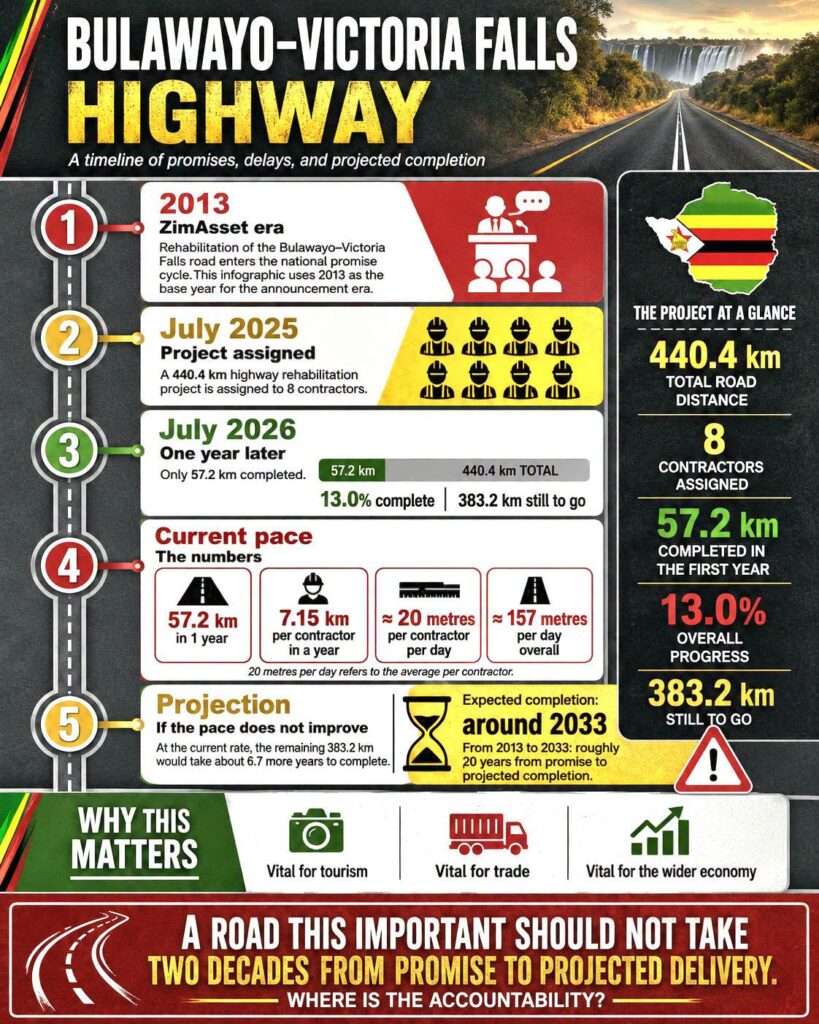
However, the hard numbers tell a story of unmitigated failure. According to the Treasury’s own Mid-Term Budget Review, only 57.2 kilometres had been opened to traffic after roughly a full year of construction. This represents a mere 13 percent of the total distance.
Worse still is the blatant statistical gymnastics used to mask this failure. Later government reports began claiming that 73.4 kilometres had been finished. Yet, a closer inspection reveals that this inflated figure includes 20.9 kilometres of “legacy works” completed long before the current project even began. When a government resorts to claiming credit for old projects to hide the failure of current ones, the presentation of progress itself becomes highly suspect.
Context makes this disaster even harder to swallow. This specific highway has been a staple of government manifestos and empty promises since the ZimAsset era over a decade ago. Zimbabweans have been subjected to an endless loop of ribbon-cutting ceremonies, grandiose progress updates, and continually revised deadlines, all while the actual road disintegrates. Tourists are forced to navigate crater-like potholes, haulage trucks suffer crippling breakdowns, and local trade is heavily penalized by the soaring costs of vehicle maintenance and delayed logistics.
If we apply basic mathematics to the Treasury’s genuine figures, the outlook is grim. With eight contractors achieving just 57.2 kilometres in a year, each contractor is averaging a laughable 7.15 kilometres annually—translating to roughly 20 meters of road per day. At this glacial pace, without major intervention, completion of the remaining stretch would take another 6.7 years, dragging this project into 2033. That is nearly twenty years after the political promise cycle first began.
This is not the kind of progress that deserves applause, nor does it warrant the endless defense from state propagandists. It is undeniable evidence of a systemic collapse in governance. It highlights woefully inadequate financing, abysmal procurement strategies, zero on-the-ground supervision, and a total absence of consequences when public commitments are broken.
In any functional, accountable democracy, responsibility for an infrastructural disaster of this magnitude would not end with another defensive press statement or yet another arbitrarily revised deadline. The buck must stop at the top. For presiding over this catastrophic failure, Minister of Transport and Infrastructural Development Felix Mhona should have done the honorable thing and resigned. Failing that, he should have been fired. Until there are real consequences for this level of failure, Zimbabweans will remain stranded on the road to nowhere.
