

By Samuel Musarika
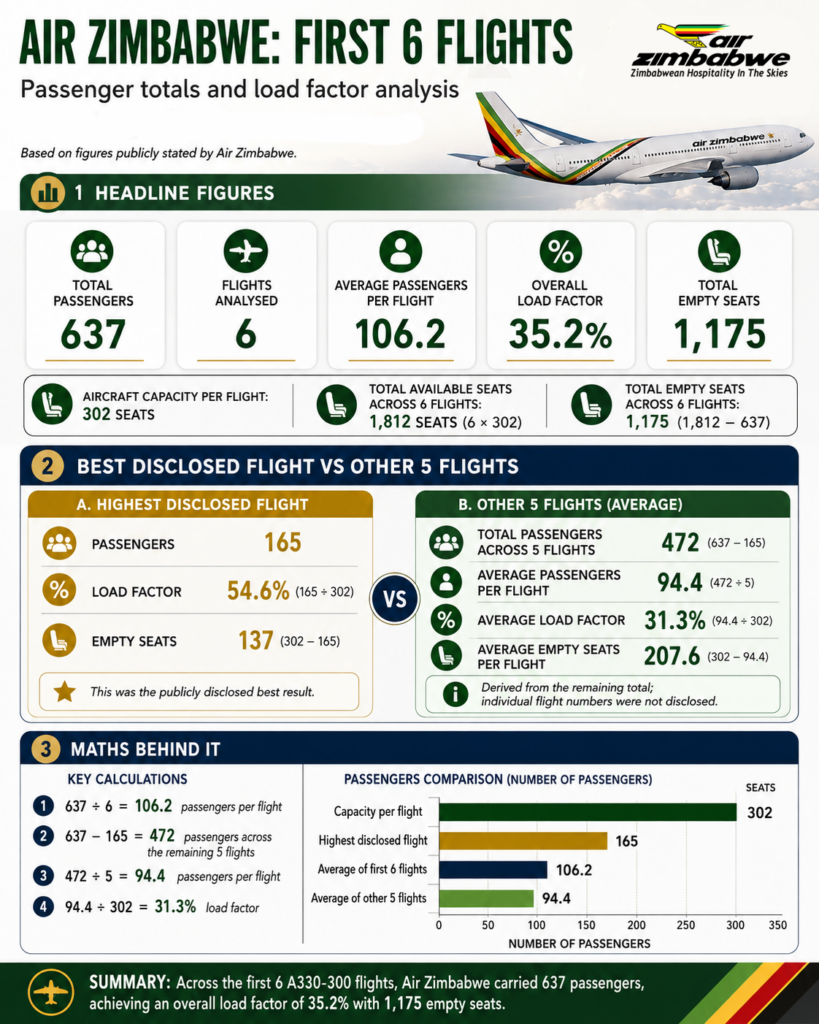
Air Zimbabwe says it carried a total of 637 passengers across its first six A330-300 flights. With each aircraft configured for 302 passengers, those six flights offered a combined capacity of 1,812 seats. This means the average number of passengers per flight was 106.2, giving an overall load factor of approximately 35.2%. In total, 1,175 seats travelled empty across the six flights.
One flight was publicly celebrated for carrying 165 passengers, which represents a load factor of 54.6%, with 137 empty seats. Once those 165 passengers are removed from the overall total, the remaining five flights carried 472 passengers between them. That gives an average of just 94.4 passengers per flight, equivalent to an average load factor of approximately 31.3%. On average, around 208 seats were empty on each of those five flights.
This does not mean that every one of the remaining five flights carried fewer than 100 passengers. Air Zimbabwe has not released the individual figures, so some may have carried more and others considerably fewer. What the arithmetic tells us is that, collectively, those five flights averaged fewer than 100 passengers each.
There is no propaganda in these calculations and no twisting of Air Zimbabwe’s words. These are figures provided by the airline itself, presented visually and mathematically so that people can assess the performance for themselves. Hopefully, Air Zimbabwe will continue publishing passenger numbers for every flight, rather than only highlighting the strongest result. Greater transparency should also include a breakdown between business class and economy passengers, because passenger totals alone do not reveal how much revenue each flight may have generated.